Why Hypnotherapy May Offer More Than BWRT
There always seems to be a “new” therapy approach appearing in the world of personal development, mental health, and behavioural change. Every few years, a new acronym, method, or branded process emerges claiming to work faster, deeper, or more effectively than previous approaches. One of the more recent examples is Brain Working Recursive Therapy, more commonly known as BWRT.
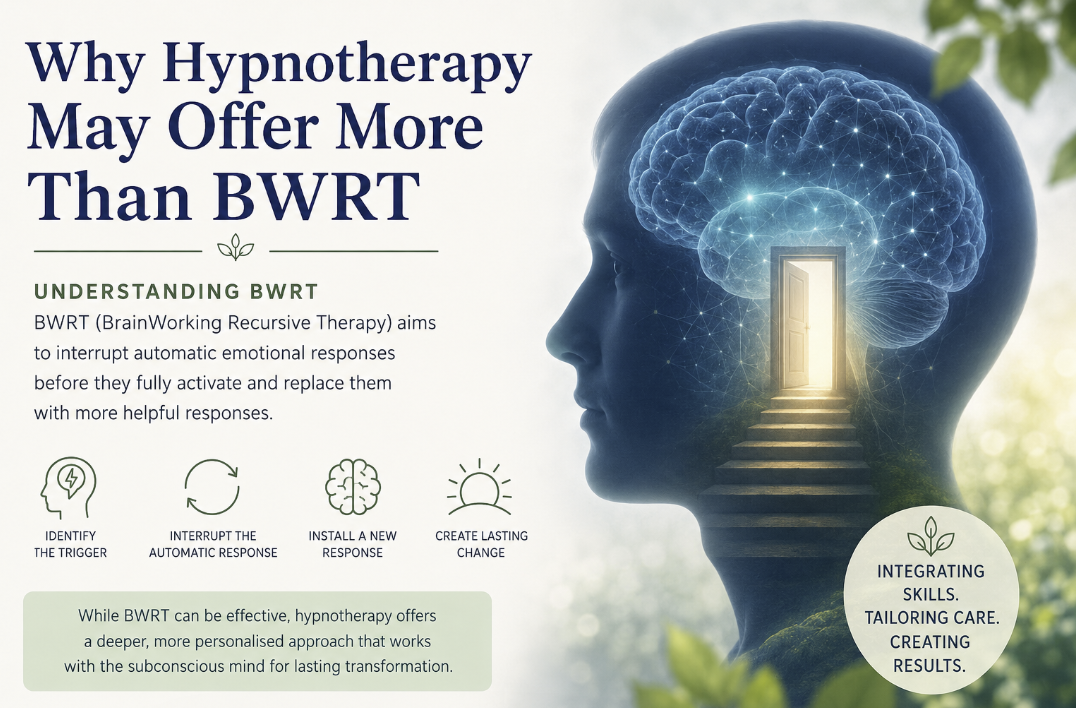
BWRT stands for Brain Working Recursive Therapy and it was developed by Terence Watts in 2011, and is based on the idea that the brain creates emotional and behavioural reactions automatically (true), often before we consciously think about them (also true). BWRT attempts to interrupt those automatic reactions and replace them with more useful responses before the emotional pattern fully activates.
In simple terms, this is a therapy which aims to:
- identify the trigger,
- interrupt the automatic response,
- and mentally rehearse a preferred outcome.
However, one of the most important things clients should understand is this:
Most “new” therapies are not entirely new.
Often, they are refinements, restructures, combinations, or rebranding of principles that therapists have used successfully for decades.
Concepts such as:
- pattern interruption, (which is a key component of BWRT)
- emotional reframing, (to ensure this occurs, timing within BWRT is critical)
- future rehearsal,
- subconscious processing,
- conditioned responses,
- visualisation,
- behavioural change,
- and emotional regulation
These have all existed across Hypnotherapy, Neuro-Linguistic Programming, counselling, behavioural psychology, coaching, and psychotherapy for many years. The real difference is rarely the label, because I believe that the real difference is the therapist.
Rather than rigidly following one branded system, a practitioner will combine techniques depending on the person sitting in front of them.
Some clients respond strongly to:
- hypnosis and hypnotherapy,
- relaxation,
- visualisation,
- and subconscious suggestion.
Others may need:
- structured coaching,
- emotional processing,
- behavioural change,
- practical accountability,
- confidence building,
- or trauma-informed approaches.
This is where integrative hypnotherapy can become exceptionally powerful. Modern hypnotherapy is not simply somebody relaxing in a chair while listening to suggestions. When practised properly, it can integrate:
- subconscious change work,
- behavioural psychology,
- future pacing,
- emotional regulation,
- NLP techniques,
- confidence building,
- somatic calming,
- emotional reframing,
- and performance enhancement.
The aim is never to force somebody into one specific framework because the aim is to help the client achieve meaningful and lasting change. Ultimately, most clients are not searching for the newest acronym, they are searching for results. Successful therapy is rarely about discovering a magical new method nobody has ever heard of before.It is about:
- understanding the person,
- applying the right techniques,
- building trust,
- adapting the approach,
- and combining methods appropriately.
For many people, that is why integrative hypnotherapy, coaching, and counselling can often offer more flexibility, more depth, and more personalised support than a single standalone approach alone.
To start your change journey, click here.