
This is a question that most people who smoke or vape have asked themselves:
“If I know it’s bad for me, why do I keep going back to it?”
It is a fair and right question to ask yourself, and one that often leads people to become frustrated with themselves. They begin to wonder if they simply lack willpower, discipline, or determination. The truth is very different.
Nicotine is one of the most effective habit-forming substances available. It works quickly, it creates powerful associations in the brain, and over time it can become linked to almost every aspect of daily life. Understanding what nicotine does to the body and mind can help explain why quitting can feel difficult, whilst also showing that freedom is entirely possible.
What Does Nicotine Actually Do?
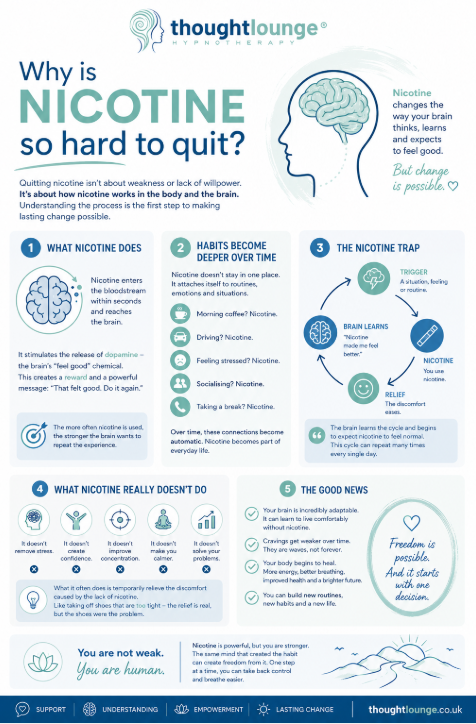
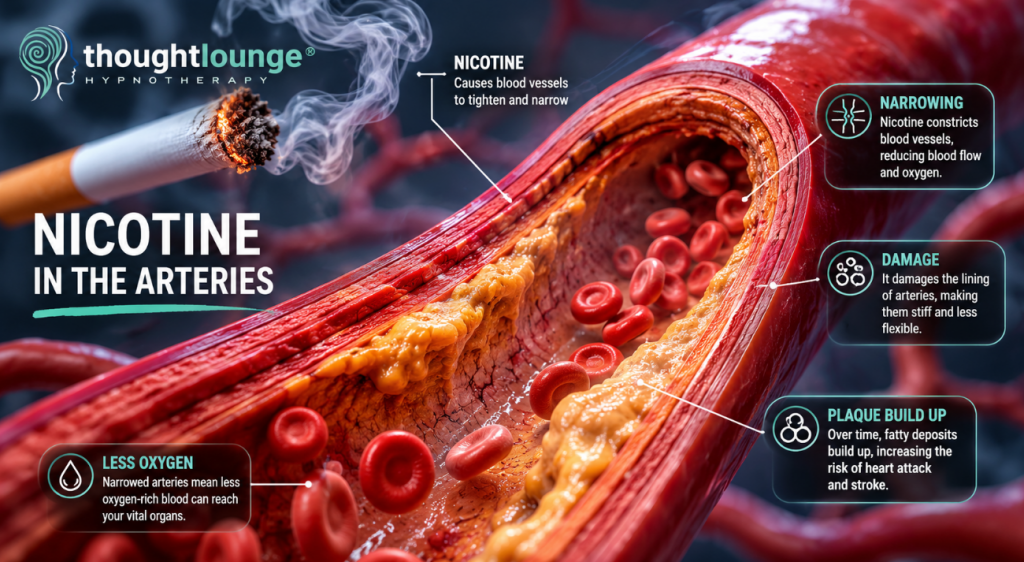
When nicotine enters the body, whether through cigarettes, vapes, patches, or other products, it is rapidly absorbed into the bloodstream and reaches the brain within seconds, it is an extremely fast affecting drug. Once there, it stimulates the release of several chemicals, including dopamine.
Dopamine is often referred to as the brain’s reward chemical. It plays an important role in motivation, pleasure, learning, and habit formation. When nicotine causes dopamine to be released, the brain receives a very simple message:
“That felt good. Remember that.”
The brain is constantly looking for ways to repeat experiences that appear beneficial, and nicotine becomes just one rather easily and repeatable experience.
The more often nicotine is used, the stronger those connections become.
Why Habits Become So Powerful
The reason nicotine is so difficult to quit is that it rarely remains an isolated behaviour. Instead, it becomes attached to routines, emotions, and situations like:
- A morning coffee may become associated with a cigarette.
- Driving to work may become associated with vaping.
- Stress may become associated with nicotine.
- Celebrations, social events, breaks at work, or simply sitting in the garden can become linked to the habit.
Over time, the brain stops viewing nicotine as something separate. It begins to weave it into everyday life AND THEN this means that when people quit nicotine, they are often changing dozens of small habits at the same time, not just one.
The Nicotine Trap
Many people believe nicotine helps them relax, cope with stress, concentrate, or feel more confident and whilst it can certainly feel that way, there is another explanation.
As nicotine levels begin to drop, the brain notices its absence. This can create feelings of irritability, restlessness, tension, or a sense that something is missing. When nicotine is used again, those uncomfortable feelings reduce.
The brain then learns that “Nicotine made me feel better.” However, what often happened was that nicotine relieved the discomfort caused by the lack of nicotine. In other words, the solution and the problem can become part of the same cycle.
This is one reason people can feel trapped despite genuinely wanting to stop.

The Good News
The encouraging news is that the brain is remarkably adaptable and just as it learned to expect nicotine, it can learn to live comfortably without it, and rather quickly too! New routines can replace old routines and new coping strategies can replace old coping strategies.
The cravings that once felt overwhelming can become weaker and less frequent.
Many people are surprised by how quickly the body begins to recover once nicotine is removed. Circulation improves, breathing often becomes easier, energy levels can increase, and many people report feeling a renewed sense of control over their lives.
It Is Not About Willpower
Perhaps the most important thing to understand is that struggling to quit nicotine does not mean you are weak and it means you are dealing with a substance that has trained your brain over many years. The challenge is not a lack of character it is a learned pattern. As I have always stated, anything that has been learned can also be unlearned.
With the right support, the right mindset, and the right approach, it is possible to break free from nicotine and create a future where smoking or vaping simply no longer feels necessary or wanted. The same brain that learned the habit can learn freedom from it.
To book a session, or talk to me, click here.