
It may be time to speak to a hypnotherapist when you no longer feel fully in control of a habit, substance, feeling or behaviour, especially when it begins affecting your relationships, work, finances, confidence or enjoyment of life. You do not need to wait until you reach rock bottom before asking for help.
Most people do not ask for help at the first sign of a problem, they wait.
Many hope that the situation will improve and that the stressful period will pass or that they will somehow find enough willpower to stop. In nearly all cases they promise themselves that tomorrow, next Monday or next month will be different. It is always drawing a line in the sand.
As you probably know, in most cases the very same pattern continues.
In my work as a hypnotherapist in Southampton, I regularly meet people who have spent months or even years trying to make a change by themselves. I would say that many arrive at the lowest point so to say, that is after a particularly difficult argument, financial loss, health concern or moment of realisation.
They often wish they had acted sooner! So, how can one recognise that it may be time to get help?
Let’s go through the signs one by one.
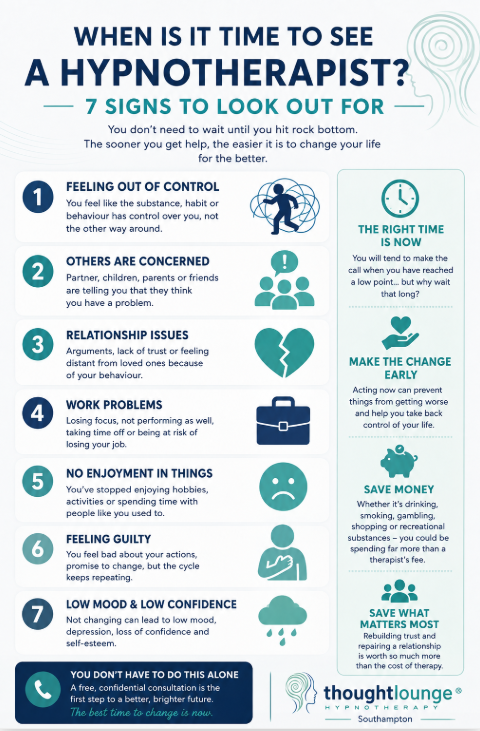
Do You Feel as Though You Are Losing Control?
One of the clearest warning signs is feeling that you are no longer making a genuine choice.
You may decide that you are not going to drink, smoke, vape, gamble, shop excessively or use a recreational substance. At the time, you mean it. Later, however, the urge returns and your earlier decision seems to disappear.
You might repeatedly tell yourself:
“This is the last time.”
“I will stop tomorrow.”
“I will only have one.”
“I deserve it after the day I have had.”
The behaviour may once have felt enjoyable, comforting or optional. Now it feels as though it has a voice of its own.
When a substance or behaviour appears to have more influence over your choices than you do, it is reasonable to seek help. You do not have to prove that the problem is severe enough. The feeling that you are losing control is itself important.
Are Other People Telling You There Is a Problem?
Sometimes the people closest to you notice the change before you are ready to acknowledge it.
A partner, child, parent or friend may comment on how much you are drinking, smoking, spending or gambling. They may notice changes in your mood, reliability, energy or personality.
Your immediate reaction may be defensive.
You might believe that they are exaggerating, interfering or failing to understand what you are dealing with. You may compare yourself with someone whose behaviour appears worse and use that comparison to reassure yourself.
However, when several people express similar concerns, or someone you trust repeatedly returns to the subject, it is worth listening.
Rather than asking, “Are they completely right?”, try asking:
“What are they seeing that I may be avoiding?”
Other people cannot make the change for you, but their concern can provide an important outside view or at least an indication of what is happening.
Is the Problem Damaging Your Relationships?
An unwanted habit does not have to be extreme before it starts affecting a relationship.
Arguments may become more frequent. Your partner may feel ignored, worried or emotionally pushed away. Trust may begin to deteriorate if you hide bottles, spending, gambling losses, messages or the true extent of the behaviour.
You may become defensive when the subject is raised or make promises you later struggle to keep.
Children may also notice far more than adults realise. They may not understand the details, but they can sense tension, mood changes, arguments and emotional absence.
The fee for seeing a therapist can initially feel like another expense. However, what is the value of protecting your relationship, preserving your family life or rebuilding trust?
A healthy relationship may be worth vastly more than the cost of receiving help.
Seeking support cannot guarantee that every relationship will be saved, but acting early may prevent further damage and demonstrate that you are taking the situation seriously.
Is It Beginning to Affect Your Work?
A problem may also show itself through changes in your working life.
You might struggle to concentrate, arrive late, make avoidable mistakes or lose motivation. Drinking may leave you tired or unwell the following morning. Gambling or shopping may distract you during the day. Anxiety may lead you to avoid meetings, presentations or opportunities.
You may still be completing your work, but doing so could require considerably more effort than before.
This can create another cycle. The behaviour causes problems at work, those problems increase your stress, and the stress then increases your desire to return to the behaviour.
The right time to act is not necessarily when you receive a formal warning or lose your job. It may be when you first notice that your performance, concentration or reliability is beginning to change.

Have You Stopped Enjoying the Things You Once Loved?
Another important warning sign is losing interest in activities, people or experiences that once brought you pleasure.
You may stop seeing friends, neglect hobbies or withdraw from family activities. Your life can gradually become organised around the habit, substance or problem.
Alternatively, you may simply feel that nothing is particularly enjoyable anymore.
Perhaps you are present physically but emotionally disconnected. You go through the motions of work, family life and social commitments without experiencing the satisfaction you once felt.
A persistent loss of interest or enjoyment can also be associated with low mood or depression, particularly when it continues for several weeks and affects everyday life. It should not automatically be assumed that hypnotherapy alone is the right response.
If your low mood has lasted for two weeks or more, you are struggling to cope, or you are concerned about your mental health, speak to your GP or you may again wish to book a session and speak to me.
Do You Regularly Feel Guilty Afterwards?
Guilt often appears when your actions are no longer consistent with the person you want to be.
You may feel guilty about money you have spent, things you have said, the amount you have consumed or promises you have broken.
You may wake up regretting what happened and sincerely decide that it will not happen again. Yet when stress, loneliness, boredom, anger or temptation returns, the pattern repeats.
Guilt can then become part of the cycle:
You engage in the behaviour, regret it and then feel guilt!
You use the behaviour again to escape the uncomfortable feeling.
The problem is not resolved by punishing yourself. Lasting change is more likely to come from understanding what triggers the behaviour, what emotional purpose it has been serving and what needs to happen differently.
Is Your Confidence or Self-Esteem Declining?
Every broken promise to yourself can weaken your sense of trust in your own decisions.
You may begin by thinking, “I am struggling to control this.”
Eventually, that thought can become, “I have no self-control,” “I am weak,” or “I will never change.”
The behaviour then begins to influence your identity.
You may feel embarrassed, withdraw from other people or avoid situations where you fear being judged. Relationship difficulties, work problems, financial pressure and repeated disappointment can contribute to low mood and reduced self-esteem.
This does not mean you are incapable of change.
It may simply mean that the approach you have been using has not addressed the thoughts, emotions and automatic responses maintaining the problem.
Why Do People Wait Until They Reach a Low Point?
People often contact a therapist following a crisis.
It might be after a partner threatens to leave, a child says something upsetting, money is lost, work is affected or a health concern becomes impossible to ignore.
A crisis creates urgency and it removes the option of pretending that nothing is wrong.
Yet, why wait for that moment?
You do not have to lose your relationship before working to protect it, you do not need to spend your savings before addressing gambling or compulsive shopping. You do not need to damage your health before changing your relationship with smoking, alcohol or substances.
Rock bottom is not a compulsory stage of recovery.
It is simply the point at which the consequences have become too painful to ignore.
You are allowed to make the decision earlier.
Could Getting Help Early Save You Money?
Smoking, drinking, gambling, shopping and recreational substances can create a substantial ongoing expense.
A relatively small daily or weekly amount can become hundreds and more than likely thousands of pounds over a year. Gambling and compulsive shopping may create even greater and less predictable losses.
Consider what the behaviour has cost you during the past month.
Then consider what it could cost over the next year if nothing changes.
A therapist’s fee is visible because it is paid at a particular moment. The cost of continuing the problem may be less obvious because it is spread across many transactions, purchases or decisions. There are also costs that cannot easily be calculated: damaged trust, reduced confidence, missed opportunities, family tension and time that cannot be recovered.
Seeking help is an expense, but continuing the problem is rarely free.
How Can Hypnotherapy Help You Regain Control?
Hypnotherapy may help you explore and change the automatic thoughts, emotional triggers and learned associations connected to an unwanted behaviour.
Most people already know consciously what they should do. A smoker knows that stopping would benefit their health and finances. Someone experiencing gambling problems understands that further gambling could increase their losses.
The difficulty is not always a lack of information.
Part of the mind may continue to associate the behaviour with relief, escape, comfort, confidence or reward. This can create a conflict between what you consciously want and what you automatically feel driven to do.
Hypnotherapy aims to help you respond differently to triggers, strengthen your motivation and imagine life beyond the existing pattern. It should be tailored to your circumstances rather than relying on a generic script or one-size-fits-all solution.
My approach begins by understanding the whole person, not merely telling someone to stop a particular behaviour.
I will leave you with the question from the beginning… Is it time to make a booking with me?

Frequently Asked Questions
Do I need to be certain that I want to change?
No. Many people feel conflicted when they first seek help. One part of you may want to stop while another part still associates the behaviour with comfort, pleasure or relief.
A consultation can help you understand that conflict and decide what you genuinely want.
Does my problem need to be severe?
No. You do not need to wait until the situation becomes a crisis.
If a habit, feeling or behaviour is affecting your happiness, choices, relationships, work, finances or confidence, it is reasonable to discuss it.
What if I have already tried to change?
Previous attempts do not prove that you cannot change. They can provide useful information about your triggers, vulnerable moments and the approaches that have not worked for you.
A different therapeutic approach may help you understand why the old pattern keeps returning.
Will a hypnotherapist judge me?
A professional therapist should focus on understanding what has happened, why the pattern is continuing and how you can move forward.
Shame and criticism rarely create useful change. Honesty, understanding and personal responsibility are far more productive.
Should You Make the Call Now?
You may be reading this because part of you already knows that something needs to change.
Perhaps you feel out of control. Perhaps someone you love has expressed concern. Perhaps your work, finances, confidence or relationship is beginning to suffer.
You could wait for another argument, another financial loss, another broken promise or another difficult morning.
Or you could act before the situation becomes worse.
People often come to me when they have tried everything else. However, you do not have to exhaust every other possibility—or reach your lowest point—before asking for help.
At thoughtlounge in Southampton, the process begins with a free, confidential consultation. It gives you an opportunity to explain what is happening, ask questions and explore whether hypnotherapy is appropriate for you.
Making the call does not mean that you have failed.
It means you have decided that your relationships, confidence, finances, happiness and future are worth protecting.
The best time to change may have been earlier.
The next best time could be now.