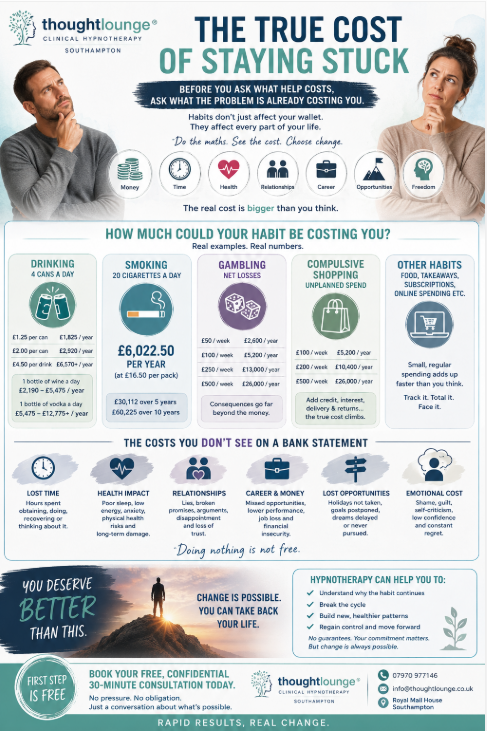
How Much Is Your Habit Really Costing You?
When people consider getting professional help, one of the first questions they often ask is:
How much will it cost me?
That is a perfectly reasonable question. However, it is absolutely not be the only calculation that matters. A better thought process may be,
“…how much could this investment save me?”
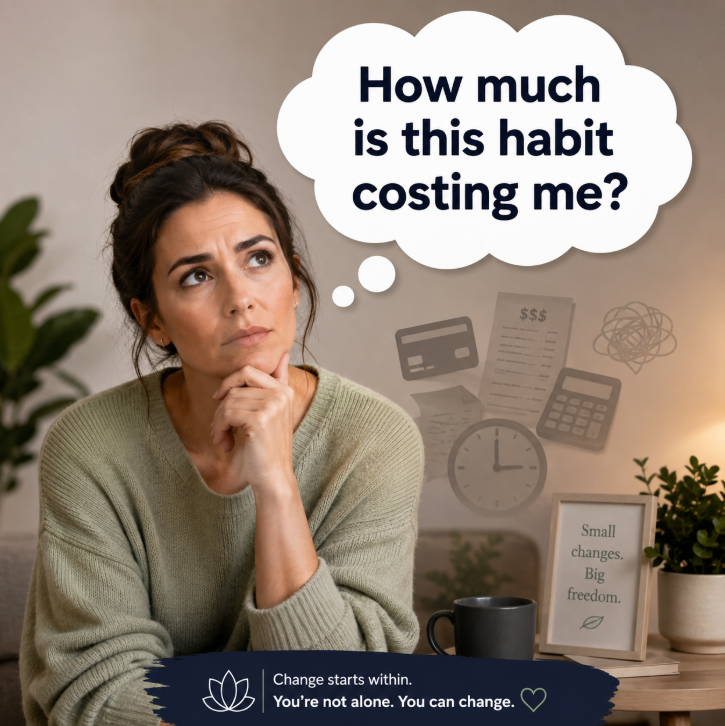
“How much is the problem already costing me?”
A habit can feel relatively inexpensive when you measure it one purchase, one drink, one packet, one bet or one online order at a time. The true cost often becomes visible only when you calculate it across an entire month, year or decade.
Even then, your bank statement tells only part of the story of course. There may also be a cost to your health, confidence, sleep, relationships, career, opportunities and peace of mind. Before deciding that getting help is expensive, it may therefore be worth calculating the true cost of staying stuck.
Why Do We Underestimate the Cost of Our Habits?
Most habits are not experienced as one large annual expense. They happen through smaller, repeated transactions.
It might be £8 spent on drinks after work, £16 on a packet of cigarettes, £30 deposited into a gambling account or £70 spent during an evening of online shopping. Each transaction can feel manageable in isolation. The mind focuses on the immediate amount rather than the cumulative cost.
There may also be a tendency to avoid looking too closely.
When someone already feels uncomfortable about a behaviour, calculating its cost can create guilt, embarrassment or anxiety. It may seem easier not to add everything together. The purpose of calculating the cost is not to shame yourself. It is to give yourself accurate information.
You cannot make a genuinely informed decision about the value of change until you understand what continuing as you are may cost.
What Does a Weekly Habit Cost Over a Year?
The simplest calculation is:
Weekly cost × 52 = annual cost
- A habit costing £25 each week costs £1,300 annually.
- At £50 each week, the annual cost becomes £2,600.
- At £100 each week, it becomes £5,200.
- At £200 each week, the annual cost reaches £10,400.
- At £500 each week, the annual cost is £26,000.
You can then multiply the annual figure by five or ten to see what the habit could cost over a longer period of course. This calculation does not include inflation, price increases, interest on borrowing or the investment growth that money might otherwise have produced. It is therefore often a conservative estimate.
How Much Could Drinking Alcohol Every Day Cost?
Consider someone drinking four cans of alcohol every day. That amounts to 1,460 cans over a year.
- At £1.25 per can, the annual cost is £1,825.
- At £2 per can, it is £2,920.
- At £4.50 per drink, perhaps because some are purchased in pubs or bars, the annual cost rises to £6,570.
The same calculation can be applied to wine.
- A £6 bottle of wine every day costs £2,190 over a year.
- A £9 bottle costs £3,285 annually
- A £15 bottle each day costs £5,475.
The health calculation matters too.
The number of alcohol units depends on the size and strength of the drink. For example, four 500ml cans at 4% alcohol would contain eight units per day, or 56 units per week. NHS guidance recommends drinking no more than 14 units a week, spread across at least three days, to keep health risks lower.
However, the true cost may well extend far beyond what was paid for the alcohol. It may include disrupted sleep, reduced energy, missed mornings, takeaways, taxis, arguments, forgotten conversations, lost productivity and the emotional cost of repeatedly promising to cut down.
For some people, drinking gradually becomes the centre around which the rest of life is organised.
The question is no longer simply:
“How much did I spend on alcohol?”
It becomes:
“What has alcohol stopped me from doing, feeling or becoming?”
An Important Safety Note About Alcohol
Anyone who experiences shaking, sweating, anxiety, nausea, hallucinations, confusion, seizures or other withdrawal symptoms when reducing alcohol should seek medical help before attempting to quit, my advice is to visit your GP.
The NHS warns that suddenly stopping alcohol can be dangerous for someone who is physically dependent. A GP or specialist alcohol service can help someone reduce or stop safely.
How Much Does Smoking Cost?
Smoking provides one of the clearest examples of how repeated spending accumulates. Using an illustrative price of £16.50 for a packet of 20 cigarettes, someone smoking one packet every day would spend:
- £115.50 each week
- £501.88 in an average month
- £6,022.50 each year
- In five years, that would amount to £30,112.50.
- In ten years, it would be £60,225—and that calculation assumes the price never increases.
The Office for National Statistics recorded an average price of £16.60 for 20 king-size filter cigarettes in January 2025, illustrating the substantial cost already attached to daily smoking. The financial cost may be considerable, but smokers frequently describe other costs too.
They may organise their working day around cigarette breaks, worry about the smell on their clothes, avoid situations in which they cannot smoke or feel frustrated that something they no longer enjoy still appears to control them.
There is also the cost of repeatedly trying to stop, returning to smoking and concluding that previous setbacks mean future change is impossible.
They do not.
A setback is information. It may suggest that the previous approach did not fully address the reasons the behaviour continued.
Hypnotherapy is not a magic process and cannot guarantee that someone will stop smoking. Commitment and participation remain important.
What Is the Real Cost of Gambling?
The cost of gambling should be calculated using net losses, rather than the total amount wagered. A person may deposit and withdraw money repeatedly, making the activity appear more complicated than it is. The important figure is the amount ultimately lost.
- A net loss of £50 each week becomes £2,600 annually.
- A loss of £100 each week becomes £5,200.
- At £250 each week, the annual loss is £13,000.
- At £500 each week, it reaches £26,000.
However, the true cost of harmful gambling is rarely limited to the amount lost. The Gambling Commission’s 2025 survey estimated that approximately 1.3 million adults in Great Britain scored eight or more on the Problem Gambling Severity Index, a category associated with adverse consequences and possible loss of control. The Commission also cautions that estimates vary according to survey methodology.
Among people who had gambled during the previous 12 months, 6.4% reported reducing their spending on everyday items because of their gambling. A further 5.9% reported lying to family, while 5.8% reported using savings or borrowed money. Relationship breakdown was the most frequently reported severe consequence.
These figures show why the cost of gambling cannot be understood by looking at betting transactions alone. It can also be the food that was not purchased, the bill that was delayed, the credit used to chase a loss, the truth concealed from a partner and the hours spent checking results or planning the next bet.
For family members, the cost may include stress, uncertainty, conflict and the gradual erosion of trust.
How Much Can Compulsive Shopping Cost?
Compulsive shopping can be particularly difficult to calculate because every purchase can be rationalised.
The item was reduced.
It might be needed later.
It can always be returned.
The payment is not due until next month.
It was only a small treat.
The true figure becomes clearer when every unplanned purchase is included, alongside delivery charges, credit-card interest, buy-now-pay-later repayments, subscriptions, unused products and items that were never returned.
- Someone spending an unplanned £100 each week is spending £5,200 annually.
- At £200 each week, the annual total is £10,400.
- At £500 each week, it becomes £26,000.
Compulsive shopping is not necessarily about wanting the objects themselves. The purchase may provide a temporary sense of excitement, comfort, control, identity or escape. Unfortunately, that feeling can be followed by regret, secrecy, unopened parcels and financial anxiety.
The cost is therefore not only the money spent.
It may also be the exhausting cycle of anticipation, purchase, relief and remorse.
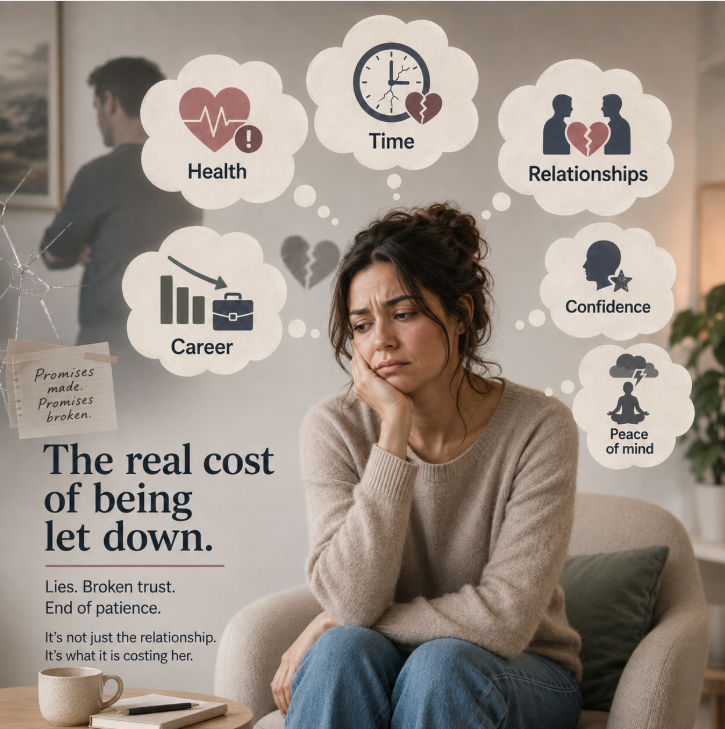
Which Costs Do Not Appear on a Bank Statement?
Money is easy to measure. Many of the most significant costs are not.
The Cost to Your Time
How much time is spent obtaining, using, recovering from, concealing or thinking about the habit?
A behaviour that consumes only two hours each day takes 730 hours over a year. That is the equivalent of more than 30 complete days.
The Cost to Your Health
The cost may appear through poor sleep, reduced energy, anxiety, low mood, impaired concentration or concern about longer-term health.
The NHS identifies harmful alcohol use, for example, as being associated with risks including liver damage, high blood pressure, stroke, heart problems, anxiety and depression.
The Cost to Relationships
Secrecy changes relationships.
Partners may stop believing promises. Conversations become arguments. The person experiencing the habit may withdraw through shame, while the people around them become increasingly watchful or suspicious.
Even where a relationship survives, trust may require considerable time and consistent behaviour to rebuild.
The Cost to Your Career
A habit can affect punctuality, attendance, energy, judgement and performance.
There may also be opportunities that are never pursued because someone does not feel confident, reliable or sufficiently in control.
The cost may be an interview not attended, a promotion not pursued or a business idea repeatedly postponed.
The Cost to Your Identity
Perhaps the deepest cost is beginning to believe that the behaviour defines you.
People may describe themselves as weak, hopeless, broken or incapable of change.
But you are not your habit.
A behaviour may have become deeply established, but it remains a behaviour. It is something you experience, not the totality of who you are.
Why Does Waiting Often Increase the Cost?
People rarely delay getting help because they do not care.
They delay because they hope the problem will improve naturally, because they feel ashamed or because they believe they should be able to solve it alone.
They may tell themselves:
I will deal with it after the holiday.
I will stop when work becomes quieter.
I will make a fresh start on Monday.
I just need more willpower.
Occasionally, this works but more often, the habit continues while the financial, emotional and relational cost accumulates. There is no requirement to wait until you have reached a crisis.
You do not have to lose a relationship, damage your health, empty your savings or reach the lowest point of your life before deciding that something needs to change.
Seeking help is not an admission of weakness. It is a decision that the current cost has become too high.
Can Hypnotherapy Help Someone Change a Habit?
Hypnotherapy aims to help a person work with the thoughts, emotional responses, associations and automatic patterns connected to a behaviour. In my work, I do not simply ask what someone is doing.
I want to understand what the behaviour has been doing for them.
- Has it provided comfort?
- Relief?
- Escape?
- Stimulation?
- Confidence?
- A reward?
- A way of avoiding a more difficult feeling?
Removing a behaviour without understanding its function can leave the original need unresolved. That is why the first session with me is designed to provide enough time to understand the whole person, explore the underlying pattern and begin the therapeutic work without rushing and get the first hypnotherapy treatment conducted.
Hypnotherapy is not something that is simply “done” to a passive client. Your motivation, commitment and participation matter, and no ethical practitioner should guarantee a particular outcome. It may also not be the only form of help required.
Serious alcohol dependency, substance addiction, severe gambling harm, eating disorders and other medical or psychological conditions may require support from a GP or appropriate specialist service.
My role is to be honest about whether I believe my approach is appropriate and whether additional support could be involved.
Is Getting Help an Expense or an Investment?
Simply put YES! The fee for hypnotherapy with me is a sound investment. That said, No one should spend money on therapy based on a promise of guaranteed success! However, it is reasonable to compare the potential cost of receiving help with the known cost of continuing the behaviour.
- If a habit costs £100 every week, it costs £5,200 every year.
- If it costs £200 each week, it costs £10,400 a year.
My aim is to completely eradicate the habit. However, even a meaningful reduction could potentially release money, time and attention for something more valuable. Perhaps the money could be used for a family holiday, repaying debt, building savings, improving your home or simply removing some of the pressure from everyday life.
Perhaps the greatest return would not be financial at all… It might be waking up without regret or being trusted again, feeling healthier and being more present with your family.
Perhaps the greatest win is gaining control again… knowing that your decisions belong to you again.
What Is Your Habit Costing You?
Take a few minutes and answer these questions honestly.
- How much do I spend on it each week?
- What does that become over a year?
- Do I borrow money, use savings or delay other purchases because of it?
- How much time does it consume?
- How does it affect my sleep, mood and energy?
- Has it caused secrecy, arguments or disappointment?
- What opportunities have I avoided or postponed?
- What might life look like if the behaviour no longer controlled my decisions?
- You do not need to answer these questions with shame.
- Answer them with curiosity.
- Awareness is not punishment. It is the starting point for making a different choice.
Take the First Step Without Any Financial Risk
I am Dr Iain Lightfoot, a clinical hypnotherapist of over 14 years, at thoughtlounge in central Southampton.
People come to me when they feel they have tried everything else. My approach combines hypnotherapy with coaching and other evidence-informed psychological approaches to understand why a pattern continues and what may help it change.
thoughtlounge has received 193 five-star reviews, but every client and every situation remains different and unique.
“I offer a free, confidential 30-minute consultation.“
The consultation gives you an opportunity to explain what is happening, ask questions and discover whether I believe I am the right person to help. There is no pressure and no obligation to proceed.
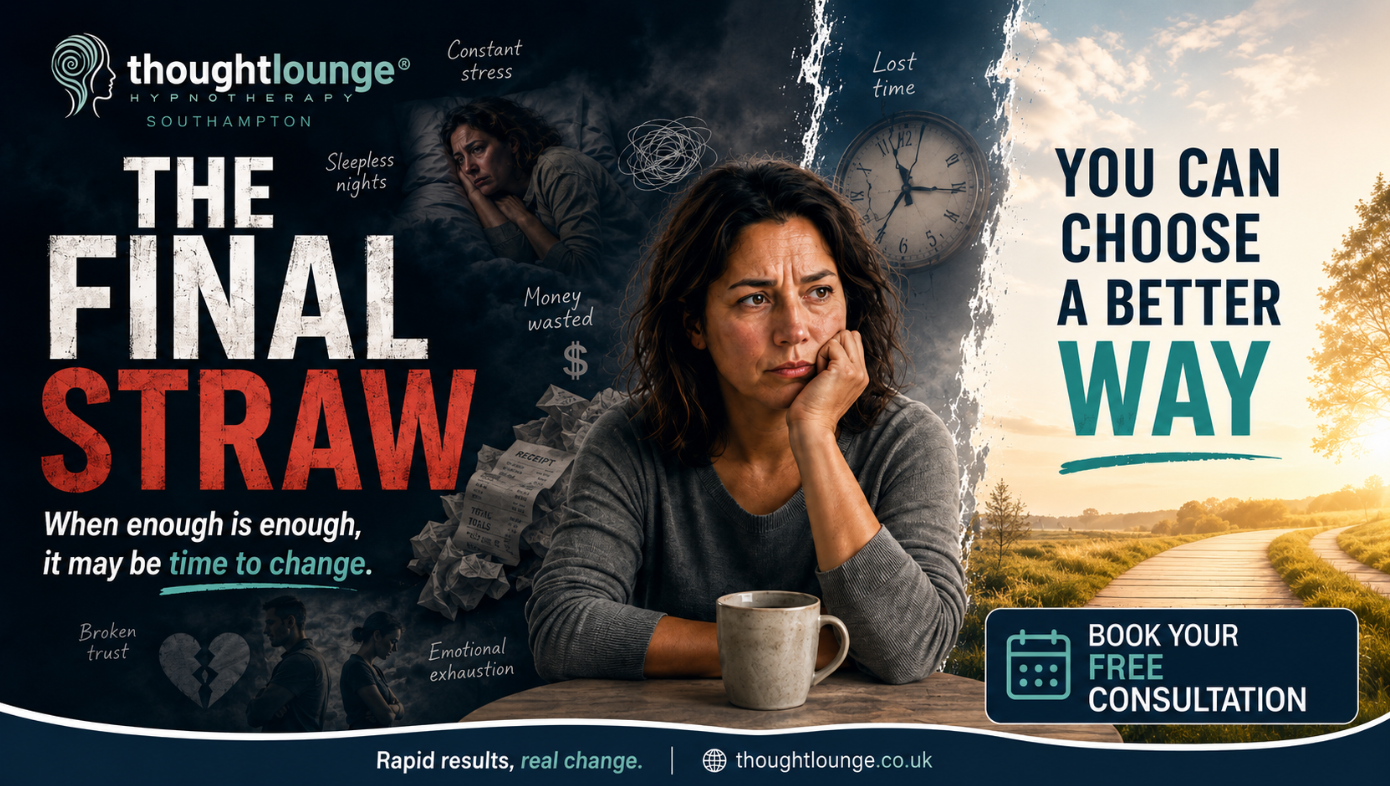
Before asking what help costs, ask what staying stuck is already costing you.
Doing nothing is not free.
Book your free consultation with thoughtlounge Clinical Hypnotherapy in Southampton.
Rapid results, real change.
Frequently Asked Questions
How do I calculate the annual cost of a habit?
Calculate your average weekly spending and multiply it by 52. Include associated costs such as taxis, takeaways, delivery charges, interest, borrowing and purchases made while under the influence of the habit.
Is hypnotherapy guaranteed to stop a habit?
No. An ethical hypnotherapist should not guarantee an outcome. Results vary, and the client’s motivation, participation, circumstances and the nature of the problem all matter.
Can hypnotherapy replace alcohol or addiction treatment?
No. Someone who is physically dependent on alcohol or experiencing a serious addiction may require support from a GP or specialist service. Hypnotherapy should not replace necessary medical, psychiatric or addiction treatment.
Is the Thoughtlounge consultation really free?
Yes. The initial 30-minute consultation is free and confidential. It allows us to discuss the problem, what you would like to achieve and whether my approach appears appropriate.
Do I have to reach rock bottom before seeking help?
No. You can seek help whenever a behaviour begins to affect your health, finances, relationships, work, confidence or quality of life. Acting earlier may prevent the cost from increasing further.