

If you have smoked for years, perhaps even decades, the idea that you could walk into a hypnotherapy session as a smoker and leave as a non-smoker can sound almost too good to be true.
I understand why you would be sceptical!
You may have tried cutting down. You may have used patches, gum or vapes. You may have stopped for a few days or weeks, only to find yourself reaching for a cigarette again when you were stressed, drinking, socialising or simply following an old routine.
So can one hypnotherapy session really help you quit smoking?
Yes, for some people, one focused session can be enough to make a significant change.
But that needs an important qualification.
Hypnotherapy is not magic, and no responsible hypnotherapist should guarantee that every smoker will permanently quit after one appointment. The scientific evidence specifically supporting hypnosis for smoking cessation remains mixed, and established NHS stop-smoking treatments and behavioural support have a stronger evidence base.
What hypnotherapy can potentially do is work with a part of smoking that many people struggle with enormously:
the habit, associations, expectations and automatic behaviours surrounding the cigarette.
Why Can Smoking Feel So Difficult to Stop?
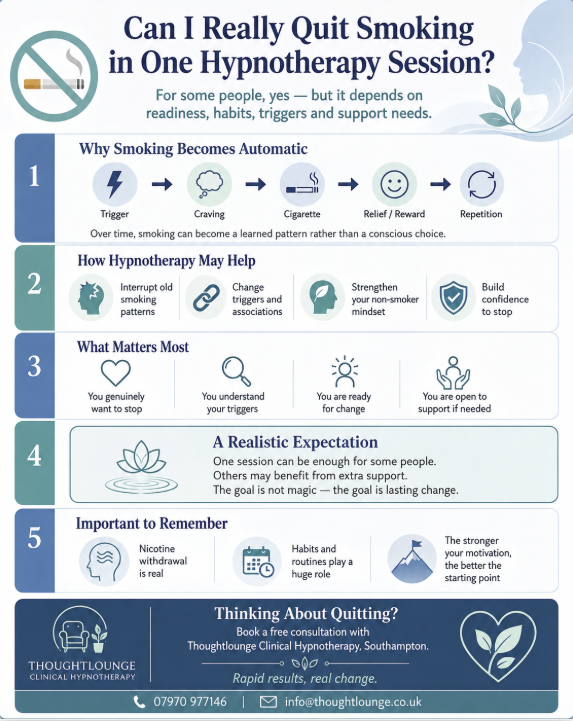
Smoking is more complicated than simply deciding whether or not to light a cigarette.
There is a physical component because nicotine is addictive. When nicotine is removed, some people experience cravings, irritability, restlessness and other withdrawal symptoms. There is also another side to smoking.
Your brain learns to associate cigarettes with particular situations.
- Coffee may mean cigarette.
- Alcohol may mean cigarette.
- Getting into the car may mean cigarette.
- Finishing dinner may mean cigarette.
- Stress may mean cigarette.
- Taking a break at work may mean cigarette.
After thousands of repetitions, you may no longer consciously think:
“I have decided that I would like a cigarette now.”
You simply find yourself wanting one.
That is where the psychological habit becomes important.
Smoking Becomes an Automatic Programme
Imagine doing the same action several times every day for 10, 20 or 30 years.
Your brain becomes extremely good at it.
Certain situations automatically activate the expectation of smoking.
It becomes a learned pattern.
And this is why somebody can genuinely want to stop smoking while another part of their mind seems determined to continue.
Consciously they may be thinking:
“I hate smoking.”
“It costs me a fortune.”
“I don’t want to damage my health.”
“I hate smelling of cigarettes.”
“I want to stop.”
Yet when the familiar trigger appears, they reach for another cigarette.
That contradiction is one of the reasons I find hypnotherapy so interesting.
Rather than simply repeating all the reasons you already know you should stop smoking, hypnotherapy can focus on changing your relationship with the behaviour itself.
What Happens During Hypnotherapy for Smoking?
Hypnosis is not about losing control. You remain aware, and you cannot be forced to do something against your will.
Instead, hypnosis can create a state of focused attention in which we can work with the thoughts, feelings, associations and automatic responses connected with smoking. For example, we might explore what cigarettes currently represent to you.
- Relaxation?
- A reward?
- A break?
- Stress relief?
- Something to do with your hands?
- Social confidence?
- A moment to yourself?
The cigarette may have acquired a psychological function far beyond simply delivering nicotine.
Once we understand that function, we can begin changing the pattern.
The objective is not simply:
“I must resist cigarettes.”
Ideally, it becomes:
“I don’t need cigarettes anymore.”
That is a very different psychological position.
Why Might One Session Be Enough?
People sometimes assume that the number of years they have smoked determines how many therapy sessions they will need.
It doesn’t necessarily work like that. A habit may have existed for 25 years, but that does not automatically mean it requires 25 sessions to change.
Think about other changes you have made in your life. Sometimes one experience, one conversation, one realisation or one decision permanently changes how you think about something.
The important question is not simply:
“How long have you smoked?”
It is:
“What needs to change for smoking to stop making sense to you?”
For someone who is genuinely ready to become a non-smoker, a concentrated hypnotherapy session may be enough to create that psychological shift. For another person, additional support may be useful.
That isn’t failure.
It is simply individual variation.
Do I Have to Really Want to Stop?
This matters enormously. Hypnotherapy is not mind control. If somebody arrives because their husband, wife, doctor or employer has forced them to attend, while internally thinking:
“Actually, I still want to smoke,”
that creates an obvious conflict.
The strongest starting point is usually:
“I’ve had enough. I want to stop.”
You do not have to feel completely confident.
You do not have to know how you are going to manage without cigarettes.
You can even feel nervous about stopping.
But there needs to be a genuine desire for change. My job is not to wrestle a cigarette away from somebody who desperately wants to keep it.
My job is to help someone who has decided that they no longer want smoking controlling part of their life.
What About Nicotine Withdrawal?
This is important because hypnotherapy should not be presented as though nicotine dependence does not exist.
Nicotine is addictive. Some people experience withdrawal symptoms after stopping, and established smoking-cessation products can help manage them. Hypnotherapy is therefore best understood as potentially addressing the psychological and behavioural side of smoking rather than pretending that physical dependence is imaginary.
For some people, dramatically changing their thoughts and expectations around smoking also changes how they experience cravings.
Others may benefit from combining psychological work with evidence-based stop-smoking support.
The goal is not to prove that one method is superior to everything else.
“The goal is for you to stop smoking successfully.”
But I’ve Tried to Quit Before
That is extremely common. Previous failed attempts do not mean you cannot stop.
In fact, they can provide useful information. Perhaps you managed perfectly well until you went to the pub.
Perhaps stress triggered you. Perhaps you smoked after an argument.
Perhaps you thought:
“One cigarette won’t hurt.”
Perhaps you stopped cigarettes but found yourself vaping constantly instead.
Instead of viewing previous attempts as failures, we can ask:
What brought the smoking behaviour back?
Because that gives us something specific to work with.
Is Hypnotherapy Scientifically Proven to Make Everyone Quit?
No. And I think it is important to be transparent about that than make extravagant promises.
So Why Do People Choose Hypnotherapy?
Often because they feel they have reached a point where smoking no longer fits the person they want to be.
They are tired of:
- planning around cigarettes,
- standing outside in bad weather,
- the smell on their clothes,
- worrying about their health,
- spending the money,
- hiding smoking from people,
- or repeatedly promising themselves that this packet will be the last one.
And sometimes they have already tried other approaches.
They are not necessarily looking for somebody to tell them smoking is unhealthy. They already know. They want help changing the behaviour.
What If One Session Doesn’t Completely Solve It?
Then we reassess. There is no prize for needing the fewest therapy sessions because the objective is the outcome.
If a person leaves a session feeling completely different about smoking and remains comfortably smoke-free, there may be absolutely no reason to keep bringing them back simply because therapy is “supposed” to take multiple sessions.
Equally, if somebody still has a particular trigger, association or difficulty, further work may be appropriate.
Therapy should be responsive to the person rather than built around an arbitrary number of appointments.
Could You Walk Out as a Non-Smoker?
Potentially, yes.
And that is the mindset I want somebody to bring into the room.
Not:
“I’ll see whether hypnosis can force me to stop.”
But:
“I’m ready to become a non-smoker. Can hypnotherapy help me make that change?”
Those are two very different starting positions.
If you are waiting for the perfect moment to quit, remember that there probably won’t be one.
There will always be another stressful week, or another party or another holiday, another excuse to buy one final packet.
Eventually, stopping comes down to a decision.
“Enough.”
And sometimes that decision can become far easier when the mind stops viewing cigarettes as something valuable that you are being asked to sacrifice.
Thinking About Quitting Smoking?
At Thoughtlounge Clinical Hypnotherapy in Southampton, the first session allows plenty of time to understand your individual smoking pattern, identify the situations and associations maintaining it, and begin the therapeutic work without rushing.
The aim isn’t to see how many sessions I can book you for.
The aim is much simpler:
to help you reach the point where you no longer need the cigarette.
For some people, one session may be enough whilst for others, additional support may be useful, either way, the first step is deciding that you are ready to change.
Book a Free Consultation
If you’re seriously thinking about quitting smoking and would like to understand whether hypnotherapy could be appropriate for you, book a free consultation with thoughtlounge Clinical Hypnotherapy in Southampton.
There is no pressure to book treatment. It is simply an opportunity to talk about your smoking, what you have tried before and what may be keeping the habit going.
Frequently Asked Questions
Can hypnotherapy make me stop smoking in one session?
Some people report stopping following a single hypnotherapy session, but no responsible practitioner can guarantee that one appointment will work for everybody. Nicotine dependence, motivation, smoking patterns and individual circumstances vary.
Will I still get nicotine cravings after hypnotherapy?
You may. Nicotine withdrawal is a genuine physiological process. Hypnotherapy may help with the psychological associations and habitual responses surrounding cigarettes, while nicotine replacement or other established smoking-cessation treatments can be considered where appropriate.
Can hypnotherapy make me quit if I don’t want to?
No. Hypnotherapy is not mind control. It works best when you have genuinely decided that you want to stop.
What if I have smoked for decades?
The length of time you have smoked does not automatically determine how many hypnotherapy sessions you will require. Long-standing behaviours can sometimes change surprisingly quickly, although outcomes vary between individuals.
Is hypnotherapy better than nicotine patches or medication?
Current research does not establish hypnotherapy as superior to established smoking-cessation interventions. NHS stop-smoking services, behavioural support and appropriate stop-smoking products have a strong evidence base. Hypnotherapy may be something you choose to explore for the psychological and habitual components of smoking.
What happens if I need another session?
Then further work can focus specifically on whatever remains — perhaps a particular trigger, situation or belief associated with smoking. The purpose is achieving a sustainable outcome rather than adhering to a predetermined number of appointments.