How the words we hear can influence the decisions we make, often without us realising.
I recently visited Specsavers, I wanted to attend for a routine eye test, and something caught my attention. Not the eye test, not the glasses, and not even the prices. It was the language.
“I also want to make clear that I had a great experience there and would recommned them. I am lijkely to buy new glasses from them soon!”
As a coach and clinical hypnotherapist, I spend a great deal of time really listening to the words people use. Not simply what they say, but how words are spoken; what those words imply; how they can influence the way someone thinks, feels or behaves.
During my recent visit, I noticed two particularly clever examples. So clever, in fact, that I found myself thinking: Someone has really thought about this.
Okay, here is what i noticed first!
Following my eye test, I was directed towards the waiting area.
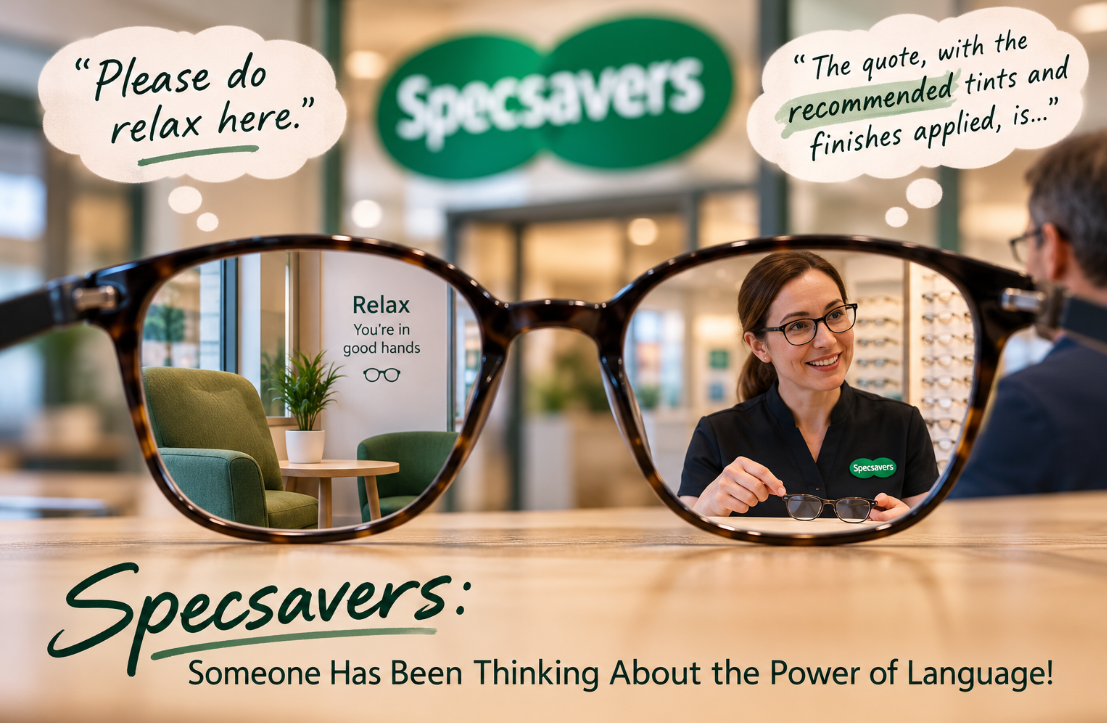
“Please do relax here.”
It was different to the rather familiar instruction, “Please take a seat here”, the wording was subtly different. “Please do relax here.”
Interesting, isn’t it? Both sentences achieve essentially the same practical outcome. The customer sits down and waits but psychologically, they’re doing something rather different.
- “Please take a seat” is an instruction to perform an action.
- “Please do relax” is an invitation to enter a particular emotional and physiological state.
The word relax brings with it associations of comfort, calmness and reassurance and the phrase gently directs attention away from the mechanics of sitting down and towards the experience of feeling comfortable. Notice the addition of the word do. It softens the instruction, making it sound almost like a personal invitation.
In hypnotherapy, I am particularly interested in how language directs attention, creates expectations and encourages particular responses. This is a lovely everyday example of that principle. Whether intentional or simply excellent customer service, I thought it was rather clever.
The Power of a “Recommendation”
The second example was even more interesting and this is where one needs to be more guarded. When it came to choosing my glasses, the conversation turned towards additional tints and lens finishes. Rather than simply asking whether I wanted these extras, the language was along the lines of:
“The quote, with the recommended tints and finishes applied, is…”
Now, read that again.
Notice the word recommended.
Recommended by whom? The optometrist? The person who has just examined my eyes? The trusted professional whose knowledge and expertise I have relied upon throughout the appointment… Or is this simply additional options being presented during the sales process? That single word changes the context of the purchase options and decision making process.
Instead of thinking, “Do I want these extras?”, a customer might find themselves thinking, “If they’re recommended, perhaps I should have them.” In fact, I would say that they circumnavigate the thought process and the person accepts the recommnedation, after all it is from a professional isnt it!
The language potentially shifts the customer’s perception from an optional purchase towards something carrying professional endorsement. Now that is powerful.
In psychology, we recognise the influence of authority. People are more likely to accept advice when they believe it comes from someone with specialist expertise.
In Neuro-Linguistic Programming (NLP), practitioners also examine the assumptions embedded within language, sometimes referred to as presuppositions.
Here, the wording encouraged the listener to accept that a recommendation has already been made, before they have considered whether they actually need or want the additional features. Now, I’m not suggesting that these products aren’t useful or that Specsavers has done anything improper. Some lens enhancements may be entirely appropriate, and I have no way of knowing whether this phrasing represents company policy or simply the language of an individual employee.
The linguistic effect is fascinating.

Are We Being Influenced Without Realising It?
Blimey! Every day, language influences our expectations and decisions. Advertisers, sales and politicians understand this. yet also highly effective coaches and therapists certainly understand it and USE it to help you…
We sometimes think persuasion requires a powerful argument, a lengthy explanation or considerable pressure, it doesn’t.
Sometimes, the difference between two perfectly ordinary sentences is enough to change how someone interprets a situation.
Consider these examples:
- “Don’t be nervous” versus “Allow yourself to feel comfortable.”
- “You need to make a decision” versus “You can decide when you’re ready.”
- “This might be difficult” versus “You may be surprised how easily you can do this.”
- “Stop worrying about it” versus “Imagine how it will feel when this is no longer a concern.”
The underlying situation hasn’t necessarily changed, we have reframed and now the language creates a different frame through which we experience it.
Of course, words aren’t magic and their effects fully depend on the person, the circumstances, the relationship and the meaning attached to them. Nevertheless, carefully chosen language can make an enormous difference.
What If We Used Language FOR Us, Rather Than Against Us?
This is where my visit to Specsavers became particularly interesting. If such subtle changes in language influence how we perceive a waiting room or a purchasing decision, imagine what could happen if we became more conscious of the language we use with ourselves. Think about your internal dialogue, how often do you tell yourself:
“I’m always anxious.”
“I can’t do this.”
“I’m terrible at making decisions.”
“I’ve never been confident.”
Each time we repeat these statements, we risk reinforcing a familiar way of thinking about ourselves. So what happens when we begin to change that language?
“I’m learning to feel calmer.”
“I haven’t mastered this yet.”
“I can make a decision and learn from it.”
“I’m becoming more confident with experience.”
These aren’t simply positive affirmations, they are alternative ways of interpreting experience, opening the possibility of change rather than reinforcing an assumed limitation. Importantly, the new language must feel believable becasue telling someone who is terrified that they are completely fearless is unlikely to achieve very much. Helping them recognise that they can learn to respond differently is potentially far more useful.
This is one of the things we explore through coaching and hypnotherapy: the words, associations, expectations and patterns that influence how people experience their lives.
The Real Lesson from Specsavers
I left Specsavers thinking less about my eyesight and rather more about what I’d heard. Someone, somewhere, understands that language matters. Perhaps I simply encountered an employee who has a particularly effective way with words! Either way, it was a fascinating reminder of something I observe every day in my work.
“The words we choose don’t just describe our experiences, they can help shape them.“
While language can be used to influence our purchasing decisions, it can also be used to support confidence, overcome unhelpful habits, reduce anxiety and encourage positive behavioural change. The next time somebody speaks to you, pay attention not only to what they’re saying, but to what their words are encouraging you to assume, feel or do.
Perhaps, more importantly though, listen to the language you use when speaking to yourself. If someone can influence how you feel about buying a pair of glasses through a carefully chosen phrase, imagine the possibilities when you begin to use that same awareness to influence your own life.
“Specsavers may have helped me see more clearly. But on this occasion, it was their language that really opened my eyes.“
I am a coach with over 20 years of experience. To book a coaching appointment, click here!