

“When love becomes a source of anxiety rather than comfort, sometimes the problem isn’t the relationship itself. It’s what your mind has learned to expect.“
Have you ever found yourself staring at your phone, wondering why your partner hasn’t replied? Perhaps their message seemed a little shorter than usual. Their tone sounded different. They were quieter over dinner. And suddenly, your mind starts asking questions.
Have I done something wrong? Are they losing interest? Is something happening that I don’t know about?
Before long, something relatively small has become something enormous and you have imagined conversations that haven’t happened, arguments that may never happen and endings that nobody has suggested. Perhaps you even are aware that you’re overthinking. you want to stop but somehow you can’t, you are unable to!
If this sounds familiar, you’re certainly not alone. Understanding why you overthink in relationships could be the first step towards feeling calmer, more confident and more secure.
Why Do We Overthink in Relationships?
Relationships matter to us for many reasons, companionship, affection, security, intimacy and a sense of belonging. For all these reasons, they matter, the possibility of losing them can feel really threatening to us. Our minds are constantly making predictions based on previous experiences. Sometimes those predictions are helpful. Other times, they become unnecessarily protective.
Perhaps you’ve experienced rejection, betrayal, criticism or an unpredictable relationship in the past. You may have learned to watch for subtle changes in another person’s behaviour, anticipating problems before they happen.
A delayed text message therefore becomes a warning and a quiet evening becomes a sign of trouble. An innocent remark becomes something to analyse for hours.
“The difficulty is that your mind may be responding to what it fears rather than what is actually happening.”
Of course, not every concern is imagined. Sometimes there are genuine relationship problems that need attention. The important distinction is learning to recognise the difference between evidence and assumption.
The Relationship Anxiety Cycle
Overthinking often follows a recognisable pattern.
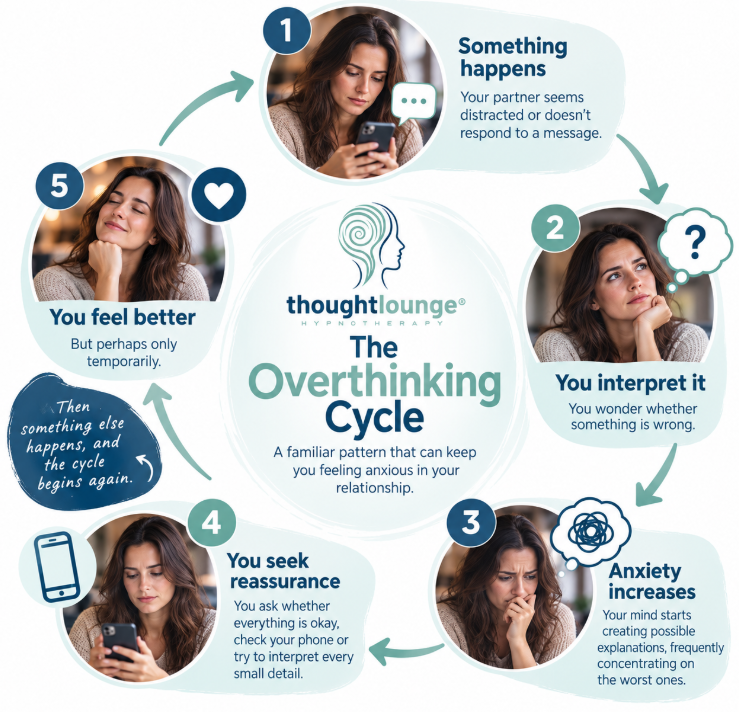
The problem with repeatedly seeking reassurance is that it teaches the mind that uncertainty is dangerous and that you cannot feel comfortable without somebody else confirming that everything is fine. Gradually, your sense of emotional security can become dependent upon another person’s behaviour.
By the way, that’s an exhausting way to live as you know.
Are You Reacting to Your Partner or to Your Past?
Here’s something worth considering.
“Sometimes you’re not responding to the person standing in front of you, you’re responding to what somebody else taught you to expect…”
Perhaps a previous partner was unfaithful or you grew up around conflict, unpredictability or criticism. You may have developed an expectation that relationships are fragile, that happiness doesn’t last or that something unpleasant is always waiting around the corner.
Those expectations can influence how you interpret your present relationship, even when the circumstances are entirely different. Imagine looking through a window that has gradually become covered in dust, the world outside hasn’t necessarily changed but the way you’re seeing it has.
Over time, old emotional experiences can act rather like that dust, colouring the way you interpret what happens around you and just as a window can be cleaned, long-established ways of thinking can be questioned, challenged and changed.
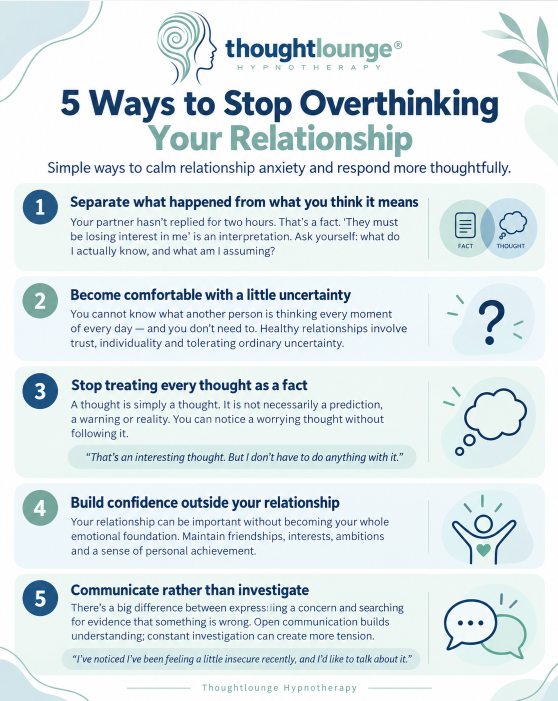
Five Ways to Stop Overthinking Your Relationship
Overthinking can turn even the smallest moments in a relationship into unnecessary worry, leaving you questioning yourself, your partner and the future. The good news is that by making a few simple changes to the way you think and respond, you can begin to break the cycle and develop greater confidence, trust and emotional security.
Can Hypnotherapy Help With Relationship Anxiety?
When overthinking has become an established habit, simply telling yourself to stop is rarely enough. You may understand logically that there’s nothing to worry about, yet still experience anxiety, uncertainty or an uncomfortable need for reassurance. That’s because emotional responses aren’t always changed through logic alone.
Hypnotherapy may be a useful complementary approach for some people who want to work on anxiety, relaxation, confidence and unhelpful thinking patterns. In my hypnotherapy practice in Southampton, I take an integrated approach, drawing upon hypnotherapy, coaching and cognitive and behavioural techniques where appropriate.
The aim isn’t to convince somebody that their relationship is perfect or that every concern is unfounded. It’s to help them develop greater emotional confidence, recognise unhelpful patterns and respond more thoughtfully to the situations they encounter.
For some, that means learning to feel calmer when their partner is unavailable. For others, it involves improving self-esteem, becoming more assertive or learning to let go of excessive worry. Hypnotherapy is not a guaranteed treatment for relationship anxiety, and where difficulties involve significant relationship conflict or trauma, specialist psychological or relationship support may also be appropriate.
What If the Relationship Really Is the Problem?
There’s one important point that mustn’t be overlooked because not every uncomfortable feeling is an overreaction. If a partner is repeatedly dishonest, dismissive, controlling or threatening, your anxiety may be telling you something important about the relationship.
The solution isn’t always to change how you think. Sometimes the solution is to establish boundaries, seek appropriate support or reconsider whether the relationship is healthy for you.
Developing emotional confidence means learning to trust your judgement, not ignoring genuine concerns.
The Most Important Relationship You Have Is With Yourself
Imagine how different life could feel if you didn’t need to analyse every conversation, if you could receive a message without searching for a hidden meaning. Perhaps learning that somebody else’s occasional bad mood didn’t immediately become your responsibility. or if you could enjoy being loved without constantly worrying about losing that love.
That doesn’t mean never experiencing uncertainty, jealousy or fear again but it means developing the confidence to experience those feelings without allowing them to control your behaviour.
“You cannot control every thought, feeling or action of another person. But you can learn to have a healthier relationship with your own thoughts and feelings.“
Sometimes, that changes considerably more than you might imagine.
Ready to Feel More Confident in Yourself?
If relationship anxiety, overthinking or a lack of self-confidence is affecting your happiness, you don’t have to keep repeating the same patterns.
At Thoughtlounge Hypnotherapy in Southampton, I help people explore and change unhelpful emotional and behavioural patterns, with an emphasis on practical, positive change.
Whether your goal is greater self-confidence, reduced anxiety or simply feeling more comfortable being yourself, we can discuss how hypnotherapy and coaching might help.
Thoughtlounge: Rapid results, real change.