
Nicotine in Plain Sight: Should the Customer Service Counter Really Be The Tobacco and Nicotine Counter Too?
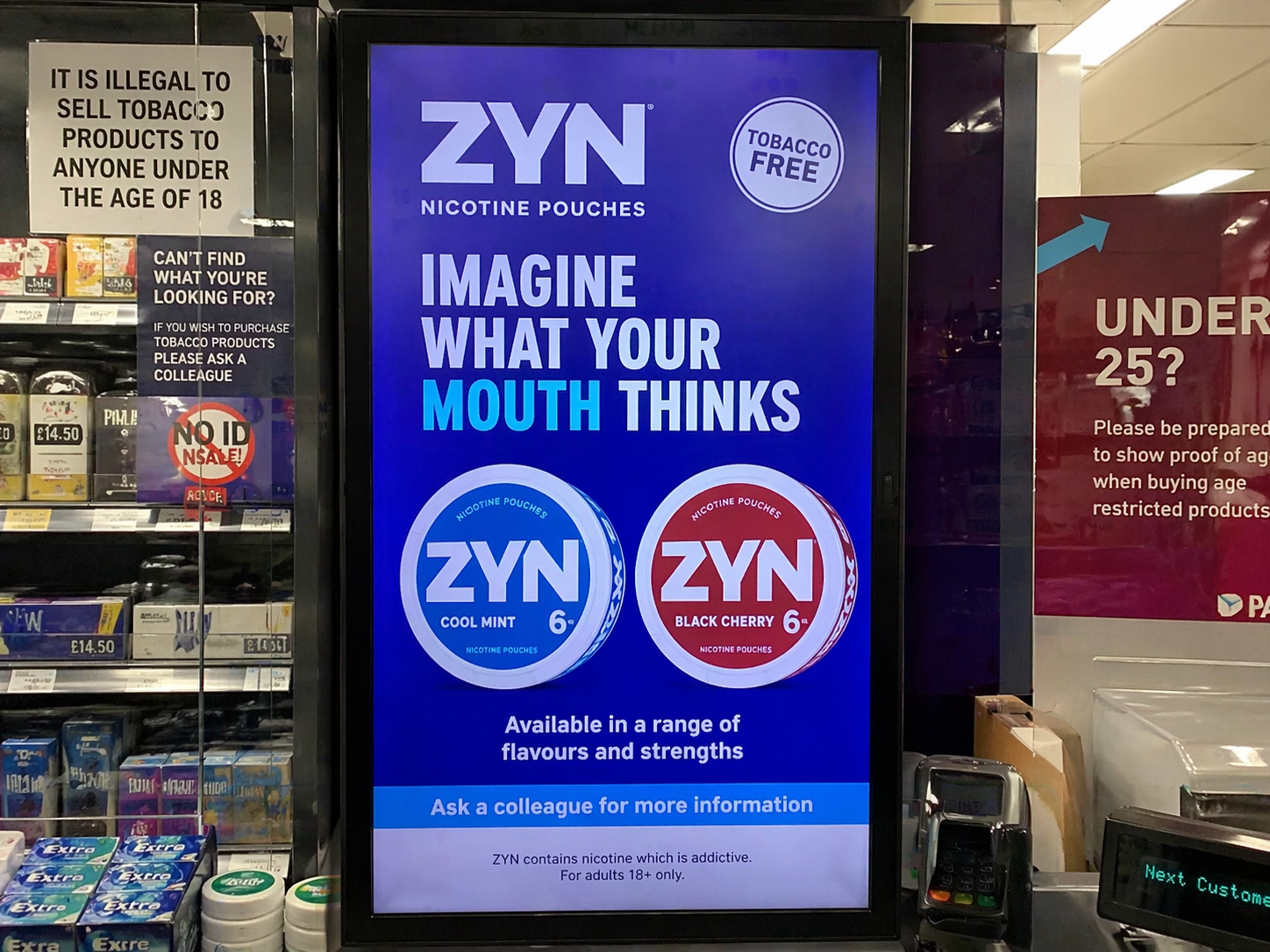
I walked into my local Sainsbury’s supermarket expecting the usual rhythm of a normal day. What I didn’t expect was to find nicotine being advertised so openly, so clearly, and so casually that, at first glance, it almost didn’t register as what it was.
This advertising partnership was taking place at the joint customer service counter and tobacco/nicotine counter. Ironically the very place families naturally gather as people return items. To me I simply saw bright packaging, polished branding, and flavour-led messaging sitting in full view. Children stood nearby with their parents. They could see everything. They didn’t need to understand it yet; exposure alone is enough to begin shaping perception. This is the place grown-ups buy their maturity.
It was completely clear, nicotine is big business. A very quick search, states that ZYN (owned by Philip Morris International) nicotine pouches is placed in a £200M market, occupying approx. £60M share and growing. It was also stated that ZYN has a 2026 advertising budget of £13.1M – Estimates suggest that the Sainsbury’s advertising may be in the region of £1000 per month per store.
In June 2025, the Government explicitly contacted Sainsbury’s to advise them that this advertising may not be legal. Yet, what I saw yesterday, April 226, this advice was being ignored.
What Is Actually Being Sold?
The products on display are not traditional cigarettes. They are part of a newer category, one that sits in a strange space between health-conscious branding and addictive substance delivery. Names like ZYN appear alongside heated tobacco systems such as IQOS and Ploom, All presented with a level of visual sophistication that feels more akin to tech products than anything historically associated with tobacco.
This is where the shift begins then, the language is different as is the presentation. You can state tobacco free but the core element remains the same, nicotine, a substance with an extremely high addictive index.
Understanding Nicotine Pouches
Nicotine pouches are small sachets which are placed under the lip, where they slowly release nicotine into the bloodstream through the gums. There is no smoke, no vapour, and no obvious external sign that they are being used. That, in itself, is part of their appeal.
They contain no tobacco leaf, which is often used as a key marketing point. Instead, they are made up of pharmaceutical-grade nicotine, flavourings, and compounds designed to enhance absorption. From a regulatory standpoint, this absence of tobacco leaf is what allows them to sit outside many of the traditional advertising restrictions.
From a behavioural standpoint, however, the body does not make that distinction. Nicotine is nicotine. It is a stimulant. It is addictive. It interacts with the brain in very predictable ways designed to cause re-purchase and habit normalisation.
The Nicotine Reality Beneath the Branding
One of the most misunderstood aspects of these products is their potency. Because they appear cleaner and more controlled, there is an assumption that they are somehow lighter or less impactful. That assumption is misleading.
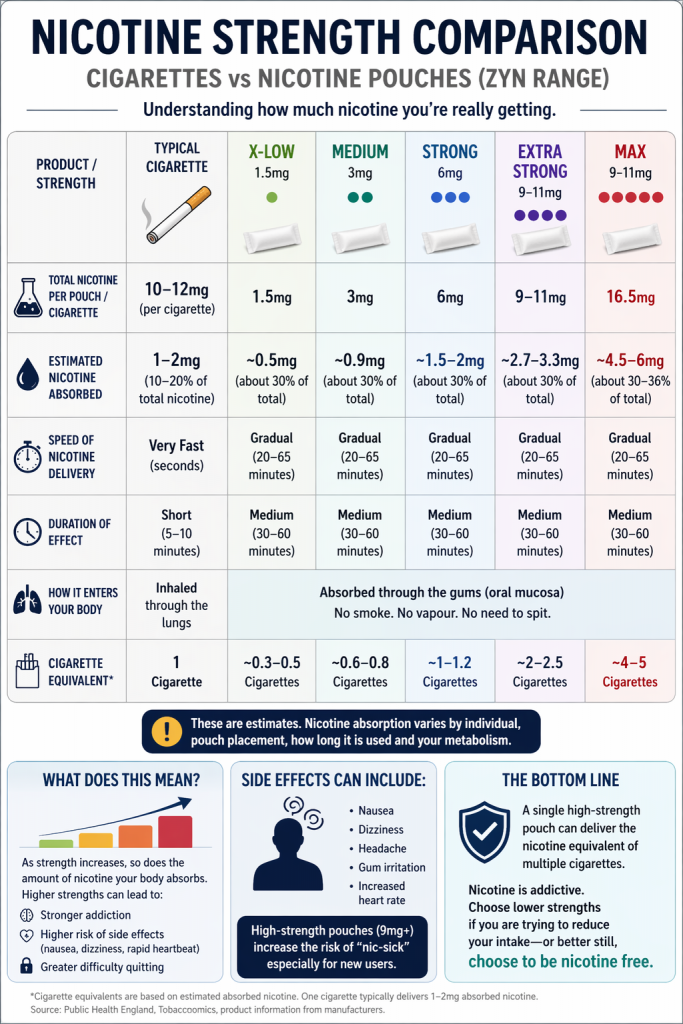
A typical cigarette delivers around one to two milligrams of absorbed nicotine. A standard nicotine pouch—around six milligrams delivers a very similar absorbed dose. However, the higher-strength versions tell a different story entirely. Some of the strongest pouches available can deliver several times that amount over a longer period.
What makes this particularly significant is not just the dose, but the delivery method. Instead of a quick spike followed by a natural pause, nicotine pouches provide a sustained release. This changes the rhythm of consumption. It removes the natural stopping points that smoking once enforced.
The result is subtle but powerful: nicotine becomes something that can be maintained continuously rather than consumed intermittently.
A Behavioural Shift, Not Just a Product Shift
From a clinical perspective, this is where the real concern lies. Addiction/Habit is not driven purely by substance. It is driven by patterns and by repetition, reinforcement, and association.
Smoking, for all its harms and 4200 poisons, has built-in limits, stepping outside to light up. There was a beginning, a middle, and an end. With pouches, that structure disappears, they can be used almost anywhere, at any time, without drawing attention.
This creates a very different behavioural loop. Instead of episodic use, you move towards constant use. Instead of visible consumption, you move towards invisible reinforcement. Instead of social friction, you get seamless integration into daily life. This is an important facet, because over time, this strengthens the dependency, not because the product is louder or harsher, but because it is quieter and easier to do.
The Power of Presentation
What struck me most in that supermarket was not just the product itself, but how it was being presented. The colours were clean and modern. The flavours were sounded familiar and appealing. The messaging was subtle but persuasive.
There was nothing overtly aggressive about it. No shock tactics. No big warnings front and centre, only small print at the bottom of the screen. Located where children can see it… This, I believe, is not accidental, but strategic
The Legal Grey Area
The reason this is happening in plain sight comes down to regulation. Traditional tobacco advertising has been heavily restricted for years. However, because nicotine pouches do not contain tobacco leaf, they fall outside those same rules.
This has created a temporary window where products containing nicotine can still be marketed in ways that cigarettes no longer can. The UK government is already moving to close this gap through the Tobacco and Vapes Bill, which is expected to bring in stricter controls, including advertising bans and tighter regulations on sale and packaging. Sainsbury’s was indeed warned in June 25 that they may be operating in a grey area here, Sainsbury’s maintaining their legality. However, are they maintaining a social responsibility? Well, I think I know the answer to that question. Supply and demand, money is king.
Why This Matters for Children
Children do not need to purchase a product to be influenced by it. They only need to see it repeatedly in an environment that feels normal and safe. A supermarket is exactly that kind of environment. It is routine. It is trusted. It is part of everyday life. We buy and consume food from there, and we are subjected to the rather large spend on research and delivery of shopping psychology
When nicotine products appear in that space, bright, accessible, and seemingly ordinary, flavoursome, they begin to lose their sense of risk in the eyes of a young observer. Over time, familiarity and normalisation builds trust. Familiarity is one of the strongest drivers of future behaviour. This is not about immediate harm. It is about long-term conditioning.
A Hypnotherapist’s Perspective
From where I sit professionally, this is deeply relevant. Nicotine addiction is not simply a chemical dependency; it is a learned pattern reinforced over time through environment, emotion, and repetition. Sanctioned by the NHS and GPs in some cases as a substitute for Nicotine.
“Recently, I heard that a GP had ‘advised’ a vulnerable patient, who has a history of heart attacks and stroke to vape instead of smoke. I am aghast. There are some research papers that suggest, due to the increased levels of nicotine, in these products that there is a higher possibility of triggering a cardiovascular event.”
Products like these accelerate that learning and they embed themselves into daily routines without interruption.
In simple terms, they make the habit easier to build and harder to break. That is why I believe that so many people find themselves stuck in nicotine addiction, not because they lack willpower, but because the system around them is designed to support continued use.
Final Thoughts
What I saw in that supermarket was shocking in an obvious way. The fact it was allowed and was taking place, was unbelievable.
Nicotine has not returned in the same form we remember. It has evolved, it has adapted and now fits seamlessly into environments where it once would have been excluded. The question is no longer whether these products are harmful in the traditional sense, no, the question is whether we are comfortable with how easily they are becoming part of everyday life once again.
If You’re Ready to Quit Nicotine…
If you’re currently using nicotine, whether through smoking, vaping, or pouches, it’s worth understanding that your experience is not a failure of discipline. It is the result of highly refined behavioural reinforcement.
The encouraging part is this: what has been learned can be unlearned.
Through hypnotherapy and structured behavioural change, it is entirely possible to step away from nicotine, not gradually but completely.
If that is something you are ready for, contact me here.