
You’ve made the decision, you really do want to stop, yet you’re still reaching for it.
This is where most people get it wrong as they assume quitting nicotine is about willpower. It isn’t. It’s about neurobiology.
What actually happens when you inhale?
Within seconds of inhaling from a vape, cigarette, or a cannabis–tobacco mix, chemicals enter your bloodstream through the lungs and reach the brain rapidly. Nicotine triggers an immediate adrenaline surge, increasing heart rate and blood pressure. Blood vessels constrict, placing strain on the cardiovascular system.
If it’s a cigarette or mixed smoke, carbon monoxide displaces oxygen, reducing delivery to tissues. At the same time, heat and chemicals irritate your airway, this is why there is a cough, the burn, the tightness.
Different formats have the same underlying problem:
- Vaping (nicotine): rapid delivery, often higher concentration which leads to dizziness, nausea, dependency.
- Cigarettes: over 4,000 chemicals, tar accumulation, severe cilia damage.
- Cannabis + tobacco: amplified heart rate (often significantly higher), increased anxiety risk, compounded addiction pathways.
So far, that’s physiology. The real issue sits deeper.
The reward system: why your brain won’t let go
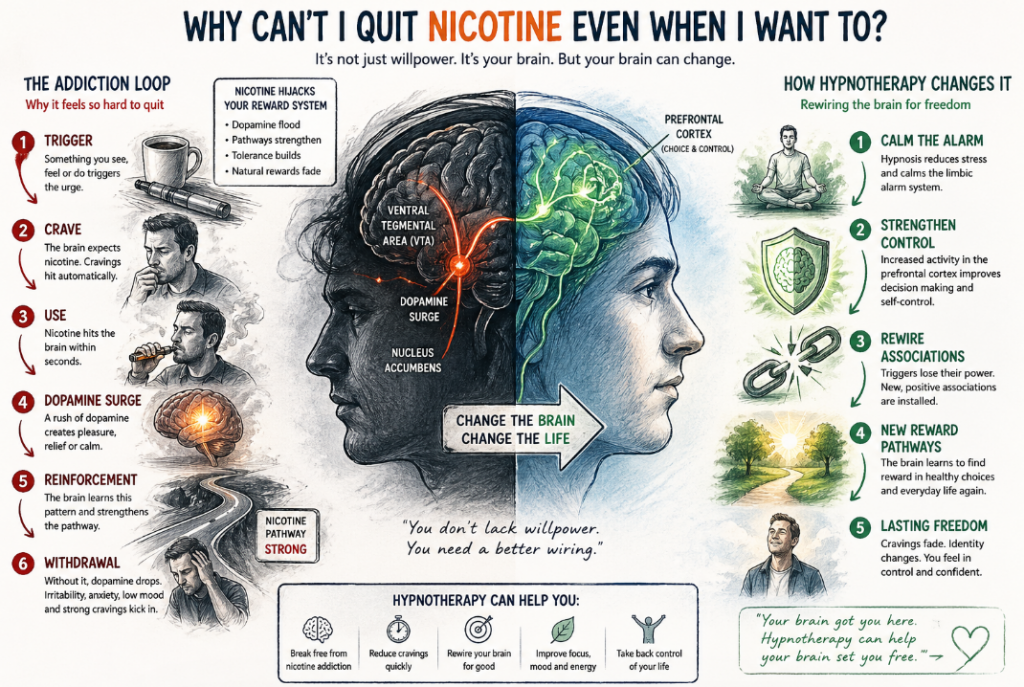
Nicotine hijacks your brain’s reward circuitry, specifically the dopamine system.
When nicotine reaches the brain, it stimulates the ventral tegmental area (VTA), flooding the nucleus accumbens with dopamine. This creates a short-lived feeling of relief, focus, or calm. Here’s the critical part: your brain doesn’t just enjoy it, it learns it.
Through a process called long-term potentiation (LTP), the brain strengthens the neural pathway associated with that behaviour. Think of it as turning a faint trail into a motorway. The next time you encounter a trigger, coffee, stress, driving etc, your brain automatically routes you back to nicotine before conscious thought even catches up.
Nicotine also increases glutamate, effectively “locking in” the memory of the reward. This is why cravings feel so automatic and so specific to environments or routines.
Over time, the brain adapts:
- It creates more nicotine receptors (tolerance)
- It reduces natural dopamine production (everything else feels flat)
- It shifts baseline mood lower without nicotine (withdrawal loop)
This is why quitting feels less like stopping a habit and more like losing a coping mechanism, a reward system, and part of your identity all at once.
Why willpower fails
You’re trying to use conscious effort to override an unconscious, reinforced neural network.
That’s like whispering instructions to a system that’s running on autopilot.
Which is why people relapse, not because they don’t care, but because the system underneath hasn’t changed.
How hypnotherapy disrupts the loop
This is where targeted interventions like “quit vaping hypnotherapy Southampton” and “stop nicotine pouches hypnotherapy” come into play.
Hypnotherapy doesn’t need to fight the habit directly, it works at the level where the habit lives, within your subconscious.
In a hypnotic state:
- The brain’s default mode network quietens, reducing automatic behaviour patterns
- Activity increases in the prefrontal cortex and anterior cingulate, improving control and decision-making
- The emotional intensity of cravings (linked to the limbic system) reduces
More importantly, it begins to recode the associations:
- Triggers lose their automatic link to nicotine
- Identity shifts from “I smoke/vape” to “I used to”
- New reward pathways are introduced and reinforced
In neurological terms, you are not “breaking” the old pathway, you are building a more efficient one that overrides it.
It’s not just nicotine
The same reward circuitry underpins other compulsive behaviours:
- “Gambling addiction”
- “Alcohol addiction”
- “Recreational substances like white powder”
- “Porn addiction”
- “Shopping addiction“
- “Weed or weed with tobacco addiction”
Different behaviours, with the exact same mechanism: dopamine, reinforcement, repetition, identity.
The bottom line
You want to quit and still struggle, because wanting happens consciously, but addiction operates subconsciously.
Once you understand that, everything changes. You stop blaming yourself. You start working with the brain, not against it.
If you’re recognising yourself in this, the question isn’t “why can’t I quit?”
It’s “am I ready to change the system that’s been running the show?”
My name is Dr Iain Lightfoot, Hypnotherapist & Coach and I work in Southampton and Hampshire. I help clients take back control, quickly, effectively, and permanently.
To book a session or talk to me in a free consultation, click here.