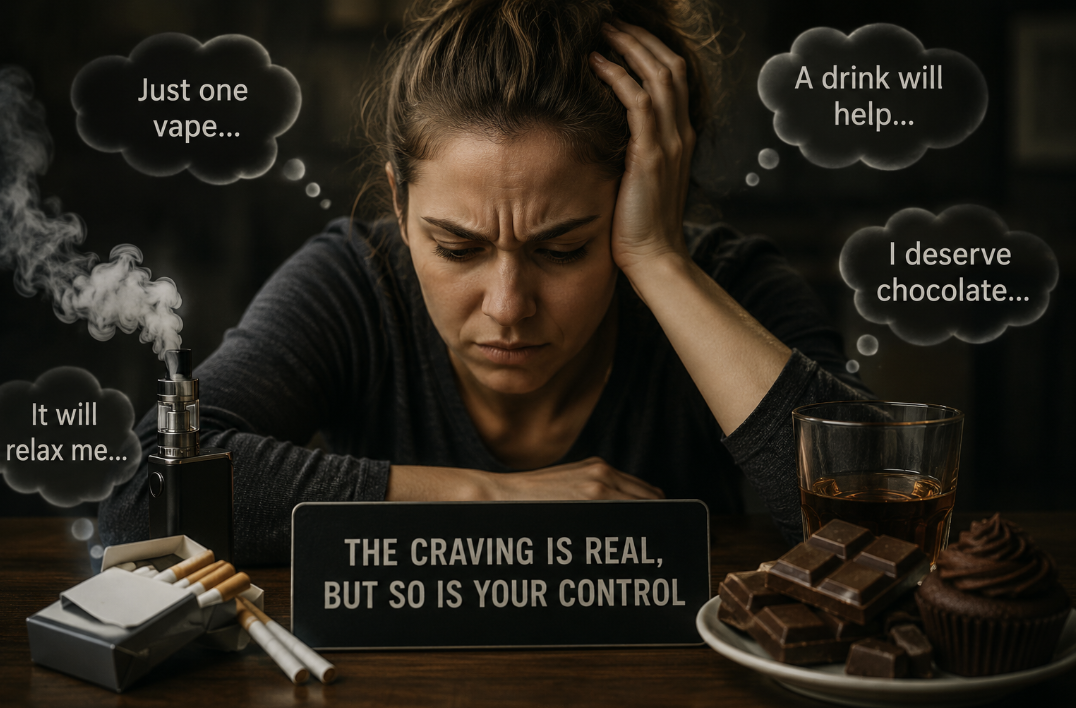
After Hypnotherapy, cravings more often simply vanish! However, sometimes cravings remain and they reduce which means they do not always instantly disappear. Many people come into hypnotherapy and they simply wake up and feel absolutely nothing at all, no draw to their old habits. Sometimes though, the process is more gradual and far more interesting psychologically.
What hypnotherapy frequently changes is the emotional drive behind the craving. Before therapy, the craving feels overwhelming and almost automatic. Like something was pulling you towards the habit, forcing you, taking your control, whether that is smoking, vaping, drinking, gambling, comfort eating or another unwanted behaviour. Afterwards, many clients often say:
“It still crossed my mind… but it felt different.”
It is this difference that really does matter.
The urgency reduces and that emotional attachment starts to weaken. The subconscious mind is seeing the behaviour differently. The old reward no longer feels quite as rewarding. Yet at the same time, routines and habits can still briefly remain.
This is because cravings are not just about the substance or behaviour itself but are linked to patterns, repetition and familiarity.
If someone has vaped every day for years while driving, drinking coffee or finishing work, the brain has linked those moments together. The subconscious mind has created pathways and associations, so even when the desire itself has reduced, the mind can still momentarily activate these old patterns.
That is why someone may think:
“Why am I still thinking about it when I don’t even really want it anymore?”
The answer is simple. The brain remembers routines extremely well. So what I often tell clients is this: a craving is not a command, it is simply a message from an older pattern of learning and the important thing is how differently you now respond to it.
Before therapy the:
- Craving controlled the reaction,
- Urge created the behaviour,
- Habit loop completed automatically.
After successful hypnotherapy:
- Often a pause,
- Awareness appears,
- Control returns,
- Choice becomes possible again.
That pause is huge psychologically and many people underestimate just how significant it is when they stop reacting automatically. That moment where you stop, think and choose differently is the continuation in session of genuine change and regained control.
An Important Note About Cravings
It is important to understand is that the nervous system does not always like change immediately, even positive change. Human beings become familiar with routines, even unhealthy ones and habits become tied to comfort, certainty, stress relief and even identity. So when those habits disappear, there can temporarily be a feeling that something is “missing.” That does not mean the habit was good for you, it simply means it was familiar.
Over time though, the brain adapts remarkably well, it is plastic! Every time you resist the old urge, the old pathway weakens. and new pathways strengthen. This is why many people suddenly notice shortly after that they had not even thought about the habit all day. Now that is a major milestone.
I also think it is important to normalise cravings rather than fear them… Some people panic the moment a craving appears and assume they are failing, which they are not. The brain is simply revisiting an old learned pattern but the difference now is that they are no longer trapped by it. Cravings often reduce in stages:
- The intensity reduces, then the frequency, and then the emotional importance.
That is where real freedom often begins.
To book a consultation, a session, or a telephone call, click here.