
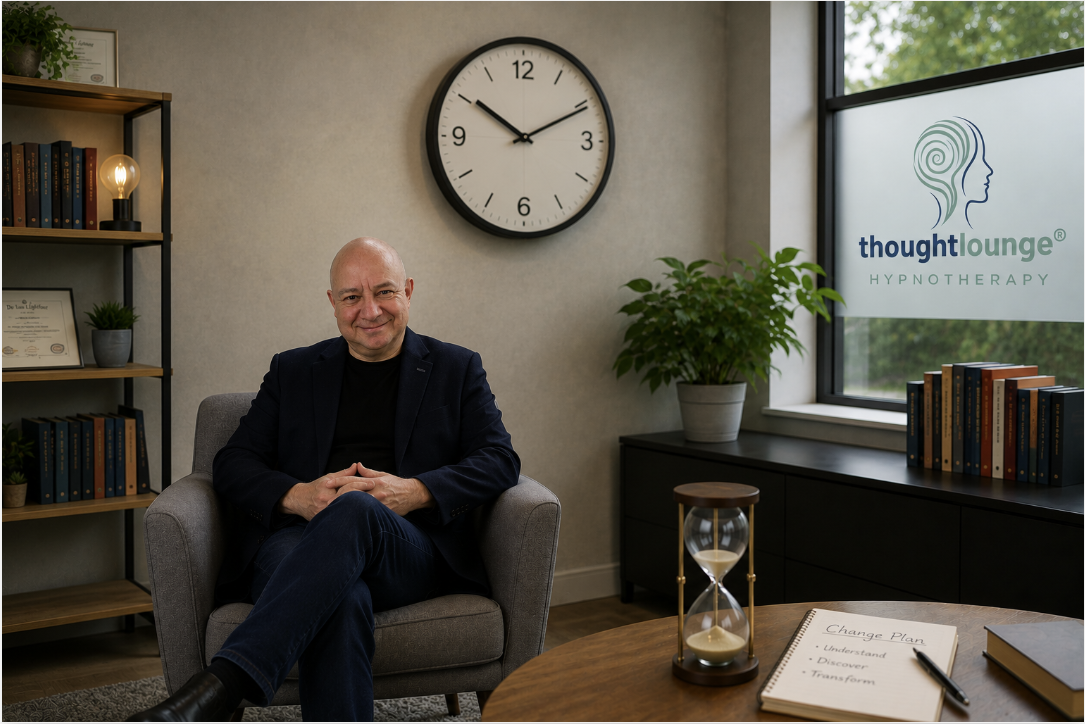
When you decide that something in your life needs to change, you probably do not want to spend weeks repeatedly explaining the same problem before anything meaningful begins. You want to feel heard and you want the person helping you to understand what is happening. Most importantly, you want to begin moving towards change. That is why my first hypnotherapy session lasts for approximately two hours.
It is not two hours of continuous hypnosis, and it is not longer simply for the sake of it. The time allows us to understand you as a whole person, explore what may be maintaining the problem and begin the therapeutic work during the same appointment.
You are not rushed through a standard process. The session is shaped around you, your experiences and the change you want to make.
Why can’t the first session be completed in an hour?
An hour can and does pass surprisingly quickly when you are discussing something that may have affected you for months or even years. We really focus on what is happening…
By the time you have described what has been happening, how it affects you and what you have already tried, much of a conventional appointment may already have disappeared. You may then find yourself being asked to return for another session before any therapeutic work has really begun.
For some people, that approach is perfectly appropriate. However, I prefer to create enough space during the first appointment to listen properly, identify important patterns and begin helping you to make progress.
Two hours gives us room to work without constantly watching the clock.
It means that you do not have to compress an important part of your life into a few hurried sentences. It also means that I do not have to make assumptions simply because there is not enough time to ask the right questions.
What happens during the first hypnotherapy session?
The first part of the session is a detailed conversation about you and the change you want to make. We will explore what is currently happening, when the problem began, what appears to trigger it and how it affects your thoughts, emotions, behaviour and everyday life. However, the conversation is not limited to the problem itself.
People are complex. Anxiety, habits, fears, addictions, confidence difficulties and emotional reactions rarely exist in complete isolation. What appears to be a single issue may be connected to stress, relationships, past experiences, beliefs, routines, unmet needs or ways of coping that once served a purpose. Understanding that wider context helps me to see the person rather than simply treating a label.
You may arrive saying that you want help with anxiety, for example, but anxiety can mean very different things to different people. One person may experience constant worry. Another may have panic attacks. Someone else may appear confident in most situations but feel overwhelmed when speaking publicly, travelling, driving or facing conflict.
The same principle applies to smoking, drinking, gambling, overeating, procrastination, low confidence and unwanted habits. The visible behaviour is important, but it is not always the whole story.
The initial conversation allows us to understand what the problem is doing, why it may still be happening and what needs to change.
Why is understanding the whole person important?
Effective therapy should not feel like something is being done to a diagnosis. It should feel like someone is working with you. Two people can seek help for what appears to be the same problem and require completely different approaches. Their experiences, motivations, personalities and circumstances may be entirely different. A standard treatment plan may describe relaxation or confidence, but it cannot automatically understand why you feel the way you do. It does not know what matters to you, what language resonates with you or what has happened in your life. That understanding comes from listening.
During the first session, I am learning about the way you experience the world. I am listening for patterns in your thoughts, language, emotions and behaviour. I am also looking for your existing strengths, because therapy is not only about identifying what is wrong.
It is also about recognising what is already working and helping you use those abilities more effectively.
You may already have demonstrated resilience, determination, courage or self-awareness without fully recognising it. These qualities can become an important part of the therapeutic process.
Does the session explore the underlying cause?
Where appropriate, we will explore what may be beneath the presenting problem. This does not mean that every difficulty must be traced back to one dramatic event. Human behaviour is rarely that simple. Sometimes there is a clear experience that changed how a person felt or behaved. At other times, a problem develops gradually through repeated experiences, learned associations, stress, avoidance or habits that have become automatic. A behaviour may also have started as an attempt to feel safer, calmer or more in control. Even when it is no longer helpful, part of the mind may continue to treat it as though it is providing protection.
Understanding the underlying structure of the problem can help us avoid focusing only on the symptom.
Imagine repeatedly silencing a warning light without checking why it keeps appearing. The light might disappear temporarily, but the underlying issue remains. Therapeutic work can be similar. Creating temporary relief may be valuable, but lasting change often requires us to understand what continues to drive the reaction.
The first session gives us time to investigate this carefully rather than jumping to a conclusion.
Will hypnotherapy begin during the first appointment?
Yes. Once we have completed the initial discussion and agreed on the direction of the work, we will begin the therapeutic and hypnotherapy part of the session. You do not have to attend a separate assessment appointment and then return at a later date before anything begins.
The conversation itself is often therapeutic. It can help you organise your thoughts, recognise patterns and see the situation from a different perspective. We can then build on that understanding through hypnosis and other appropriate therapeutic approaches.
The hypnosis is tailored to what we have discussed. Rather than simply trying to force away a feeling or behaviour, the work may focus on changing associations, increasing emotional control, strengthening confidence, reducing automatic reactions or helping you imagine and rehearse a more helpful response.
The exact approach will depend on you and what you want to achieve.
Will I be hypnotised for the entire two hours?
No.
Hypnotherapy is much more than spending two hours with your eyes closed while someone speaks to you.
The hypnotic element is only one part of the process. The discussion beforehand provides the information needed to make the hypnosis relevant and purposeful. Hypnosis is generally experienced as a focused and relaxed state of attention. You remain aware, you can hear what is being said and you do not lose control.
You cannot be forced to reveal secrets or do something against your values. You are not asleep, unconscious or powerless.
The aim is to help you engage with ideas, images and suggestions in a focused way so that new responses can begin to feel more natural. The quality of the preparation often influences the quality of the therapeutic work. Spending time understanding you allows the hypnosis to connect directly with your experiences, goals and preferred way of thinking.
Why is it important not to rush?
Many people seeking hypnotherapy have already tried to change by themselves. They may have used willpower, read books, listened to recordings, downloaded apps, spoken to friends or attended other forms of therapy. Some have made progress for a while before finding that the old feelings or behaviours returned. By the time they seek professional help, they may feel frustrated, disappointed or worried that nothing will work for them.
That deserves more than a hurried conversation.
Not rushing allows us to consider what has already been attempted and why it may not have created the result you wanted. It also gives you the opportunity to ask questions and become comfortable with the process. Therapy works best when it feels collaborative. You should understand what we are doing and why we are doing it.
A two-hour appointment creates time for that collaboration to develop without delaying the start of the actual work.
Do I need to prepare for the first session?
You do not need to arrive with a perfectly organised explanation. Many people are unsure why they feel or behave as they do. That may be one of the reasons they are seeking help. You can simply explain what has been happening in your own words.
It can be useful to think about what you would like to be different after therapy. Rather than focusing only on what you want to stop, consider what you would like to experience instead. How would you know that the change had happened? What would you be doing differently? How would you feel? What would other people notice?
These questions help us create a meaningful direction for the work.
However, you do not need to solve the problem before you arrive. That is what the session is there to help you explore.
Is a two-hour first session right for everyone?
The session is designed for people who are genuinely seeking change and who want enough time to explore their situation properly. You do not need to know exactly how hypnotherapy works, and you do not need to be certain that it will be the right approach before making contact.
That is why I offer a free initial consultation.
The consultation gives you an opportunity to explain what you would like help with, ask questions and decide whether you feel comfortable working with me. It also allows me to consider whether my approach is suitable for your circumstances.
There is no pressure to proceed. The purpose is to help you make an informed decision.
Can meaningful progress really begin in one session?
Every person and every situation is different, so no responsible therapist should promise that every issue will be completely resolved within a single appointment. However, meaningful progress can certainly begin during the first session. You may leave with a clearer understanding of what has been happening, a different perspective on the problem and a stronger sense that change is possible.
The therapeutic work also gives your mind an opportunity to begin responding differently. Some people notice an immediate shift. For others, the change develops over the following days as they recognise that their thoughts, feelings or automatic reactions are beginning to alter.
The purpose of the extended first session is not to guarantee an instant cure. It is to give us the strongest possible foundation for effective work and to begin that work without unnecessary delay.
Is it time to begin making a change?
Seeking help can feel like a significant decision, particularly when you have lived with a problem for a long time or tried several ways of overcoming it. You may wonder whether your difficulty is serious enough, whether you will be understood or whether change is genuinely possible for you.
The first session is designed to give those questions the time and attention they deserve. We will explore what is happening, consider what lies beneath it and begin working towards the outcome you want. You will not be rushed, reduced to a label or asked to wait through several appointments before the real work starts.
The process begins by understanding you.
To find out whether hypnotherapy could help you, book a free consultation and take the first step towards the change you want to make.
To book your consultation, click here.